To add value to this article, we must address a common question: can you connect a turntable to an amplifier? This depends on the amplifier’s age and whether it has a phono input. Older amplifiers typically do, but many modern ones don’t due to the decline in turntable usage. However, there is now a resurgence in vinyl interest.
An audio amplifier comprises four sections:
- Preamplifier input stage with a selection switch for different inputs.
- Voltage amplification stage.
- Tone control stage.
- Power amplification stage.
The Curves used in RIAA – pre-emphasising and de-emphasising
This would apply to the frequency response at which we set the corner frequencies i.e. lowering bass and increasing treble and vice versa.
The RIAA network has two LCR filters, (Inductance, Capacitance and Resistive), to be more precise, usually only Resistive and Capacitive, one setting the 50Hz and 500Hz corner frequency and the other, the 2122kHz corner frequency. These filters are design around a time constant of 3180uS/318uS for the bass region and other, 75uS, the high frequency time constant.
You Tube
RLC Band Stop Filters and Band Pass Filters
Low Pass Filters and High Pass Filters – RC and RL Circuits
Tape Recorders and Equalisation
Two common types of equalisation are NAB and IEC.
NAB (National Association of Broadcasters) Equalisation Curve – IEC2: This standard uses two corner frequencies, 50Hz and 3180Hz, with time constants of 3180uS and 50uS. It is used with reel-to-reel tape machines at various speeds.
Purpose of NAB
The NAB curve was designed to address the limitations of playback electronics in the 1950s by rolling off high frequencies above 3150Hz and boosting low frequencies below 50Hz.
NAB Reels and Hubs:
The term “NAB” also refers to the reels and hubs used in the professional range of reel-to-reel tape recorders, particularly those with 10 1/2 inch reels.
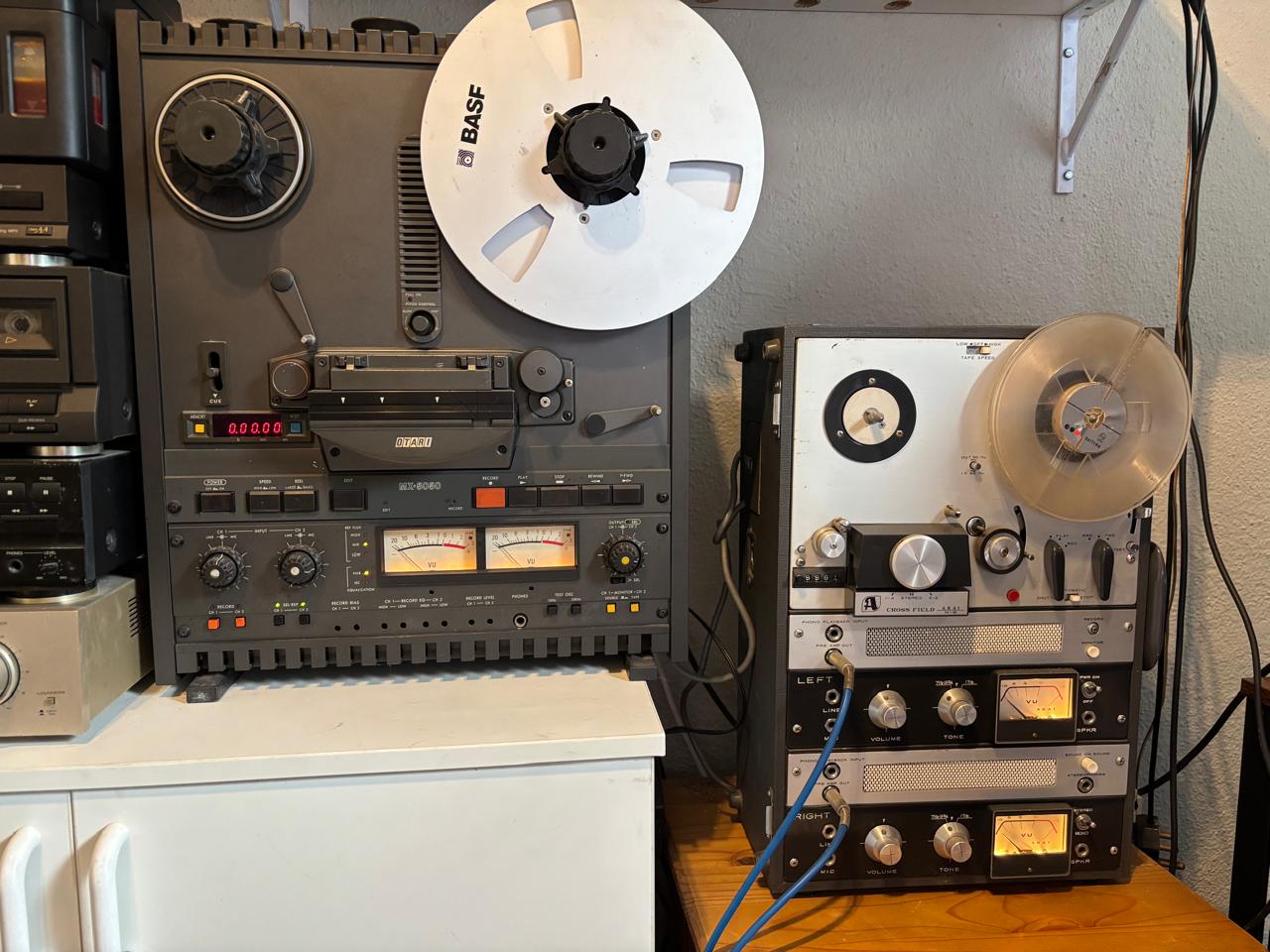
Otari MX5050BII professional recorder showing NAB reels – this model can be set for IEC1 and IEC2 equalisation.
The IEC standard
IEC or the International Electrotechnical Commission originally known as the European CCIR standard or Comité Consultatif International pour la Radio (Swiss I think). This includes video and digital audio.
The IEC1 Equalisation Curve
IEC1 (CCIR) is an equalization curve used in tape recording to compensate for the frequency response limitations of magnetic tape, particularly the high-frequency roll-off.
The Purpose of IEC1
This system boosts high frequencies during recording and reduces them during playback to ensure the signal sounds as intended. The boost rolls off at 4500Hz.
Note that IEC1 has only one transition frequency.
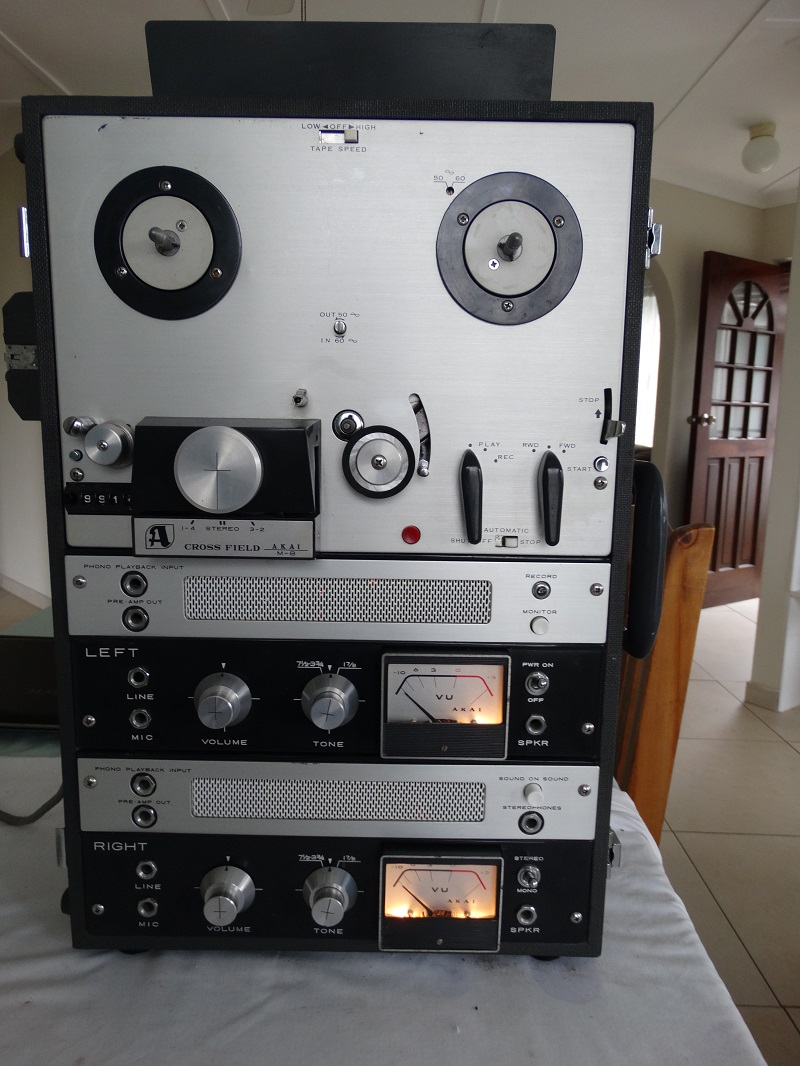
The Akai M8 Cross Field bias
The Akai M8 featured three heads: a record/playback head, an erase head, and a bias head located opposite the record/playback head, positioned behind the magnetic tape.
Head Block of the Akai M8 / Roberts 770X showing Erase, Record and Playback heads – note the bias head opposite the PB/REC head.
The AKAI M8 Equalisation on Turntable Reproduction:
The Akai M8 uses the NAB equalisation curve for recording and playback, rather than the RIAA curve. The RIAA network has two LCR filters for 50Hz and 500Hz, and 2122kHz, while the NAB uses 50Hz and 3180Hz. In my experience, even with turntables from 1968 like the Garrard SP25 with a crystal cartridge, or testing with a Technics 1200 with an MM cartridge, the reproduction quality was good. For more information on transition frequencies, refer to the Magnetic Reference Laboratory.