Table of Contents
ToggleEssential Transistors for the Electronics Beginner
Here we start a four-part series on active components, tying in nicely with our recent Arduino and Raspberry Pi articles. This series is written for newcomers to electronics and draws from my own hands-on experiences over decades in repair, maritime radio, and hardware distribution. We’ll reference key academics and designers while touching on lesser-known semiconductor devices — and the still-relevant thermionic valve (vacuum tube).
Which Were the Most Important Transistors Ever Developed?
The MOSFET (Metal-Oxide-Semiconductor Field-Effect Transistor) stands as the most important transistor ever developed. It revolutionised computing, telecommunications, and consumer electronics through scalable, highly efficient mass manufacturing. Modern microprocessors pack billions of microscopic MOSFETs onto a single silicon chip, powering the digital age.
The history of transistors highlights four foundational devices that built the modern electronics industry:
- Point-Contact Transistor (1947) • Inventors: John Bardeen, Walter Brattain, and William Shockley (Bell Labs) • Industry/Category: Telecommunications & Analog Audio • Significance: The world’s first working transistor. Built using germanium and gold foil, it replaced bulky, fragile, and hot vacuum tubes for signal amplification.
- Bipolar Junction Transistor (BJT, 1948) • Inventor: William Shockley (Bell Labs) • Industry/Category: Consumer Electronics (Radios & Hearing Aids) • Significance: Easier to manufacture than the point-contact type and highly reliable. It powered the 1954 Regency TR-1 (first commercial transistor radio) and early hearing aids.
- MOSFET (1959) • Inventors: Mohamed Atalla and Dawon Kahng (Bell Labs) • Industry/Category: Digital Computing & Microprocessors • Significance: The most manufactured device in human history and the fundamental building block of modern digital electronics. Its design enables incredibly fast switching and extreme scaling per Moore’s Law.
- FinFET / Gate-All-Around (GAA) Transistors (2010s–Present) • Industry/Category: High-Performance Computing (AI, Smartphones, Gaming) • Significance: These 3D structures solved quantum leakage issues in sub-22nm planar MOSFETs, powering today’s advanced chips.
Moore’s Law and Its Impact
Gordon Moore (1929–2023), co-founder of Intel, observed in 1965 that transistor counts on microchips would double roughly every year (later revised to every two years). This self-fulfilling prophecy drove the Silicon Cycle, massive scaling, and dramatic cost reduction — turning multi-million-rand mainframes into everyday smartphones.
Today, Moore’s Law has slowed due to physical limits like quantum tunnelling. The industry now emphasises 3D stacking, chiplets, and specialised accelerators.
The Transition from Germanium to Silicon
Early germanium transistors offered a unique “audio warmth” but were fragile and leaky. Silicon brought stability, low cost, and ruggedness — enabling the explosion of consumer hobby electronics.
Workhorse Transistor Timeline
1950s: Germanium Era • OC71 / OC72 (Mullard): First mass-produced black-glass germanium transistors — backbone of early pocket radios. • AC128: Legendary PNP power transistor famous for the Fuzz Face guitar pedal used by Jimi Hendrix (prized for soft, musical distortion).
1960s: Silicon General-Purpose • 2N2222 (1962): Iconic NPN in TO-18 metal can — the most famous general-purpose transistor. • 2N3904 (NPN) & 2N3906 (PNP): Motorola’s affordable plastic TO-92 pair — standard low-power switching/amplification. • BC547 (NPN) & BC557 (PNP): European/Asian equivalents (note different pinout: C-B-E vs E-B-C).
1970s–1980s: Power & MOSFETs • 2N3055: Rugged TO-3 metal “diamond” NPN power transistor — the workhorse of linear supplies, audio amps, and motor control. • 2N7000 / BS170: Small-signal N-channel MOSFETs for high-speed, voltage-controlled switching on the breadboard.

Essential Spares Box Checklist
Stock 10–20 of each of these core pairs and you’ll cover ~95% of DIY projects, sensors, audio amps, and microcontroller interfaces.
Category | Part Number | Type | Key Specs | Best Used For |
Low-Power Signal | 2N3904 / BC547 | NPN Silicon | 40V, 200mA | Small relays, sensors, LED projects |
Low-Power Signal | 2N3906 / BC557 | PNP Silicon | 40V, 200mA | Complements to the NPNs above |
Rugged General | 2N2222 / PN2222 | NPN Silicon | 40V, 800mA | Small motors, higher-current loads |
Medium Power | BD139 / BD140 | NPN/PNP Pair | 80V, 1.5A | Audio output stages, medium motors |
High-Current Darlington | TIP120 / TIP125 | NPN/PNP Pair | 60V, 5A | Microcontroller switching of heavy loads |
Logic-Level MOSFET | 2N7000 | N-Channel | 60V, 200mA | Ultra-fast digital switching |
High-Power MOSFET | IRF540N | N-Channel | 100V, 33A | PWM motor control, LED strips, inverters |
Power Transistors for Audio Amplifiers
The Classic Metal Kings: 2N3055 (NPN) & MJ2955 (PNP) • Package: TO-3 metal “diamond” • Specs: 60V, 15A, 115W • Essential for linear bench supplies and vintage PA amplifiers. The metal case doubles as the collector — great for learning thermal management with heatsinks and mica insulators.
The Hi-Fi Audio Masters: 2SC5200 (NPN) & 2SA1943 (PNP) • Package: TO-264 / TO-3P plastic • Specs: 230V, 15A, 150W • Toshiba originals excel in high-end home theatre and stage amplifiers. Easier modern mounting than TO-3 cans.
Complementary High-Power MOSFETs for Hi-Fi Audio
Lateral MOSFETs (Best for Linearity & Thermal Stability) • Exicon ECX-10N/P, ECX-16N/P • Renesas/Hitachi 2SK1058 & 2SJ162 (now sought-after for servicing) • Toshiba 2SK1530 & 2SJ201
Vertical MOSFETs / HEXFETs (Best for Raw Power) • Vishay/IR IRFP240 & IRFP9240 — ubiquitous, low-cost DIY favourite • Fairchild/ON Semi FQA10N80C & FQA9P25 — excellent for high-power designs
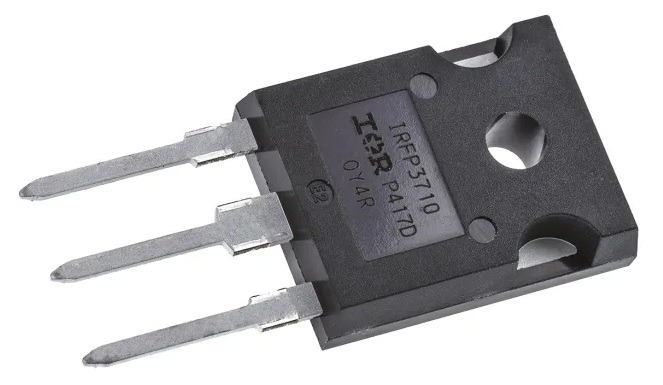
Heavy Power Section for the Spares Box
Part Pair (NPN/PNP) | Package | Core Strengths | Best Project Uses |
2N3055 / MJ2955 | TO-3 Metal | High current, rugged vintage | Linear supplies, dummy loads |
2SC5200 / 2SA1943 | TO-264 | High voltage, low audio distortion | Class-AB amps, heavy motor drivers |
Warning on Counterfeits
The 2SC5200/2SA1943 pair is heavily faked. Buy from reputable distributors (RS Components, Mantech, Communica, etc.) rather than cheap auction lots.
How Specialists Detect Fakes (Non-Destructive):
- Collector-Base Capacitance (Ccb) Test — Genuine parts measure ~200–280pF; fakes are often under 90pF.
- High-Current Breakdown Testing — Push close to datasheet limits on a curve tracer. Fakes fail dramatically.
Temu & Budget Marketplaces They can work for low-stress hobby circuits, but genuine parts provide the safety margin needed for audio amps and power supplies. Clones often pass basic tests but fail under real load.
Pro Tips for Your Spares Box • Start with silicon NPNs (most projects use low-side switching). • Always verify pinouts (2N3904 is E-B-C; BC547 is C-B-E). • Germanium transistors (AC128 etc.) only for vintage effects or old radios — they degrade faster.
Trip down memory lane: The AD161 and AD162 Complimentary pair
The AD161 (NPN) and AD162 (PNP) were incredibly popular, industry-defining components during the late 1960s and early 1970s. They served as the quintessential “transitional” power workhorses right before silicon took over the market completely.
Why They Were Highly Popular
Prior to the AD161/AD162, building a push-pull audio amplifier out of Germanium transistors required using two identical PNP transistors hooked up to a heavy, expensive, and distortion-prone audio output transformer.
The AD161 and AD162 changed the consumer audio industry by offering a factory-matched complementary pair (NPN + PNP) capable of handling up to 3 Amps. This enabled engineers to design “transformerless” Class-B audio output stages.
- The Look: They are immediately recognizable by their unique, elongated capsule shape with a mounting tab (often referred to as a TO-66 or modified TO-3 outline) designed to bolt directly onto an aluminium heatsink.
- The Applications: They became the definitive power block for 1970s mains-powered home radios, portable stereos, and especially car radios (such as vintage Philips and Grundig units). They typically pumped out a clean 4W to 11W of audio power.
Can You Still Buy Them?
Yes, you can still buy them, but they are not found at standard modern component retailers like DigiKey, Mouser or a local electronics components reseller.
- New Old Stock (NOS): Millions of these transistors were manufactured by European semiconductor giants like Philips, Siemens, Telefunken, and Tungsram. Because the industry pivoted rapidly to Silicon (like the BD139/140 series), vast warehouses of unused, original factory stock were left behind. You can regularly purchase these genuine NOS parts on eBay or from specialized vintage radio restoration suppliers.
- Online Marketplaces: Clones and leftovers are widely available on platforms like AliExpress and Amazon.
- Niche Specialized Manufacturers: Interestingly, niche European fabricators (like Comset Semiconductors in Belgium) bought up old factory tooling to explicitly keep obsolete Germanium lines like the AD162 in low-volume production for industrial maintenance contracts.
Why People Still Buy Them Today
There are two primary reasons these 50-year-old Germanium parts remain in active circulation:
- Strict Vintage Restoration (The Preservation Crowd)
A Germanium transistor has a forward base-emitter voltage drop Vbe of roughly 0.2V to 0.3V, whereas a Silicon transistor drops 0.6V to 0.7V. If you simply drop a modern silicon transistor into an old 1970s Philips car radio without re-engineering the entire biasing resistor network, the circuit will suffer from massive, unlistenable crossover distortion or outright thermal runaway. Restorers buy the AD161/AD162 to keep classic audio gear performing exactly to its original factory specifications without redesigning the PCB.
- The “Germanium Sound” (The Audiophile & Guitar Crowd)
Much like the AC128s used in guitar fuzz pedals, the AD161/AD162 pair is sought after by DIY audio enthusiasts building boutique, low-power amplifiers. When pushed to their clipping limits, Germanium junctions naturally create smooth, even-order harmonics. This delivers a soft, warm “valve-like” distortion that modern silicon switches cannot easily mimic without complex digital modelling or filtering networks.
What to Look out for
My first audio amplifier used AD161/162 output transistors. Although it was from a “Popular Electronics” circuit and gifted to me, my father decided he’d rather build it and well, sadly could never get it to work. Being a radio valve enthusiast, I don’t know what he did wrong but I rebuilt it and got it working but one thing I learnt very quickly, Germanium transistors and thermal runaway were close companions.
Another way of spotting if you have bought a fake semiconductor
I have done many videos on my channel in the past about fake semiconductors , here is just another simple way to confirm if its fake or not. Channel Michael Dranfield
Further Reading
- Power Switching Semiconductors: Thyristors, IGBTs, GTOs, SIDACs & Wide-Bandgap Devices Explained (2026) – Part 2
- Counterfeit Semiconductors & Other Electronics – Elliott Sound Products
- Mosfets >50W – Eltim Exicon
- Maplin 150W MOSFET audio amplifier
- The Arduino Revolution – From Italian Student Project to Global Maker Powerhouse
- My Complete Guide to a Smart Home: What It Is and How It Works – cnet.com
- 5 Websites for smart home enthusiasts – Smashing Hub
- Home Assistant – Home
- DC Blinding Warning: 6mA RDC-DD, Type B RCD & SANS 10142-1 in South Africa
- Solar Panel & Battery Theft in South Africa: The Growing Crisis – And a Simple, Smart Detection Solution
- The Silent Killer in Your EV Charger Installation: Why Your Cheap “ELCB” Could Get Someone Electrocuted (And Why Municipalities Are About to Crack Down)
Technical Research
- Featured image: Grundig TK121 – board. Attribution © Raimond Spekking /CC BY-SA 4.0 (via Wikimedia Commons)
- Legendary Transistors 2N3055. CC BY-NC-SA 2.0 Author Valmirez
- Research: Technical assistance and cross-referencing provided by X’s xAi Grok and Google’s Gemini Ai model.
- Editorial: All case study data, circuit designs, and final editorial decisions are the sole responsibility of the author to ensure technical accuracy