Type B RCD EV charger: If you’re installing a Type B RCD for EV charger setups in South Africa, this article could save lives — and prevent massive future headaches with your municipality.
A recent MyBroadband piece highlighted the shocking reality: many electricians are cutting corners with cheap standard earth leakage units because proper RCDs are expensive and in short supply. That decision could blind your entire home’s shock protection the moment a DC leak occurs from the car’s battery system.
This isn’t scaremongering. It’s physics — and it’s already happening with solar inverters and EV chargers across the country.

Table of Contents
ToggleThe Voltronic Parallel: We’ve Seen This Movie Before
Thousands of South Africans installed affordable Voltronic/Axpert inverters that allegedly lacked proper isolation or neutral-earth switching. When municipalities started auditing, homeowners faced massive retro-fit bills and illegal installations.
EV charging is the next wave. Municipalities like City Power and Cape Town see EVs as the revenue replacement for solar grid-defection. But a 7.4 kW Level 2 charger runs like two or three geysers continuously. Unmanaged loads will stress suburban networks, and non-compliant installs will get flagged fast via smart meter data.
Don’t be the person paying thousands later to fix what should have been done right the first time.
Old ELCB vs Modern RCD: Why Terminology Still Confuses Electricians in SA
In South Africa, electricians still casually call the main earth leakage unit an “ELCB.” Technically it’s usually a current-operated RCCB or RCBO (Residual Current Circuit Breaker / with Overcurrent).
- Old Voltage-Operated ELCBs (phased out): Measured voltage on the earth wire. Needed a perfect earth. Easily bypassed. No good against direct live touches.
- Modern Current-Operated RCDs: Monitor balance between live and neutral. Detect tiny leaks (30 mA) through a person to ground — even without a perfect earth.
The problem? Most standard domestic units in SA DB boards are Type AC — they only handle pure sinusoidal AC. EVs introduce smooth DC leakage currents that can saturate (blind) the sensor
The DC “Blinding” Hazard Explained
Type B RCD EV charger - why we use them
Simple analogy (Stuck Valve): Your standard earth leakage is like a balanced scale. Live current in must equal neutral current out. A fault tips the scale and trips the breaker.
A DC leak from an EV battery or onboard charger is like dropping a heavy brick on one side of the scale. The scale is now pinned down. Even if you touch a live wire elsewhere in the house, the mechanism can’t move. Protection is paralysed.
Technical explanation (Magnetic Saturation): Standard Type AC (and even many Type A) devices use a toroidal current transformer core. AC creates alternating flux that the device detects. DC creates a constant magnetic field that drives the core into saturation. Once saturated, the core’s permeability drops near zero — it can no longer detect AC faults reliably.
This applies to high-voltage solar battery banks too (400–600 V DC).
Device Types – What You Actually Need for EVs
Type | Detects | Suitable for EV Charging? | Notes |
Type AC | Pure sinusoidal AC only | No – Unsafe for EVs | Common cheap “ELCB” in SA boards |
Type A | AC + pulsating DC | Minimum if charger has 6 mA DC protection | Better, but not full protection |
Type B | AC + pulsating DC + smooth DC | Recommended / Often required | Gold standard for EVs & solar |
SANS 10142-1 (especially Annex N for EV infrastructure) demands 30 mA protection for shock safety. Higher ratings (100/300 mA) are for fire protection only.
Practical Advice for South African Installations
Check your charger first: Does it have built-in 6 mA DC detection (RDC-DD per IEC 62955)? If yes, you can often use a good Type A upstream. If not, you need Type B at the board.
Recommended options available in SA:
- Budget/Intermediate: Chint NB1L Type A variant (specify Type A when ordering — look for the ~ + pulsating DC symbol on the front). Good 6 kA RCBO for 32 A chargers (use 40 A breaker).
- Premium: Schneider Acti9 iID Type B-SI, ABB F200 Type B, or Suntree/Tongou Type B units stocked by EV specialists.
Expect to pay R5,000–R12,000+ for proper Type B gear. Cheap R300 Type AC units are false economy.
Installation checklist:
- Dedicated circuit with 25% headroom (40 A for 32 A / 7.4 kW charger).
- Minimum 6 kA breaking capacity.
- Surge protection (SPD).
- Proper labelling and CoC referencing SANS 10142 Annex N.
- Verify with your specific charger datasheet.
US Comparison (for split-phase 120/240 V folks)
In the USA they use Class A GFCI breakers (4–6 mA trip, UL 943) — functionally stricter equivalents. Siemens, Eaton, Square D double-pole GFCIs are common for EV circuits. The principle is the same: match protection to the DC risk.
Why Type B Units Cost So Much (And Why They’re Worth It)
Type B isn’t just a bigger coil. It’s a miniature embedded system:
- Passive magnetic core for AC.
- Active fluxgate sensor + microprocessor for smooth DC.
- Internal power supply.
Low production volumes + rigorous certification (IEC 62423) drive the price. But it’s the only way to guarantee protection against modern power electronics.

Who Else Needs This? (Cross-Industry Warning)
- EV owners — obvious.
- Solar + battery owners — especially high-voltage hybrid systems.
- Farmers — agrisolar setups powering pumps and cold rooms with wet environments.
- Electricians & TVET trainers — curricula must catch up to power electronics and DC monitoring.
Final Warning + Call to Action
Fly-by-night installers using standard Type AC breakers are creating liability time-bombs. A proper Type B RCD for EV charger installation costs more upfront but protects your family, your insurance, and your wallet long-term.
Insist on seeing the Type symbol on the device your electrician installs. Ask for the charger’s technical specs showing DC protection.
The green energy transition is exciting — but only if it’s done safely and legally.
Have you had your EV charger installation South Africa checked? What RCD did they use? Share your experience below and help spread awareness.
Parts-Ring.com – Stocking proper EV charging components and helping South Africans do it right the first time.
Stay safe, stay compliant, and keep those wheels turning. 🚗⚡
(Always consult a registered electrician for your specific installation. Regulations evolve — verify latest SANS requirements.)
Further Reading
- Next Up: EV Chargers powered by Coal
- The Connected Machine: How IoT is Revolutionizing Automotive, Marine, and Cooling Systems – A Real-World Smart Geyser Case Study
- Ampacity and Neher-McGrath
- Evnex New Zealand – Do I need a Type B RCD for my EV charger?
Technical Credits & Research
Visuals: Image assets generated by Google’s Gemini AI and PicsArt
Research: Technical assistance and cross-referencing provided by Grok xAI and Gemini.
Featured Image Distribution Board . Provided by PixaBay Author Image4You
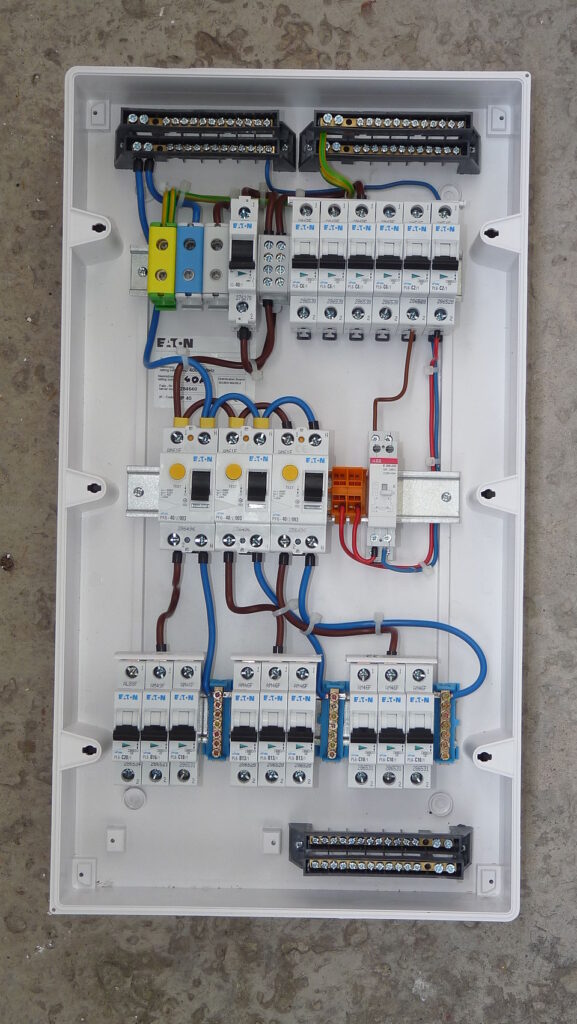
- Consumer Distribution Board showing RCDs – Wiki: This file is licensed under the Creative Commons Attribution-Share Alike 3.0 Unported license. Author Dmitry G
Editorial: All case study data, circuit designs, and final editorial decisions are the sole responsibility of the author to ensure technical accuracy.
- Inspired by Mr A. Ahmed