Table of Contents
ToggleThe 2030 Horizon: Smart Agriculture & Physical AI
The Invisible Farm: How IoT and Robotics are Feeding the Future
1. The Role of IoT: Survival and Efficiency
In South Africa, IoT (Internet of Things) has evolved from a “smart home” luxury into a critical tool for national resilience.
Energy Management: With the evolution of the grid, IoT-enabled inverters and smart meters (like those from Victron or Sunsynk) are now essential “parts.” They allow real-time monitoring of power usage, ensuring homes and businesses stay online during shifts in supply.
Smart Agriculture (Agri-Tech): This is the frontline of the revolution. South African farmers are global leaders in adopting LoRaWAN sensors to monitor soil moisture and Satellite/Drone-based vision to identify crop stress. By using the “part” as a sensor, we can reduce water usage by up to 30% and increase yields by nearly 25%.
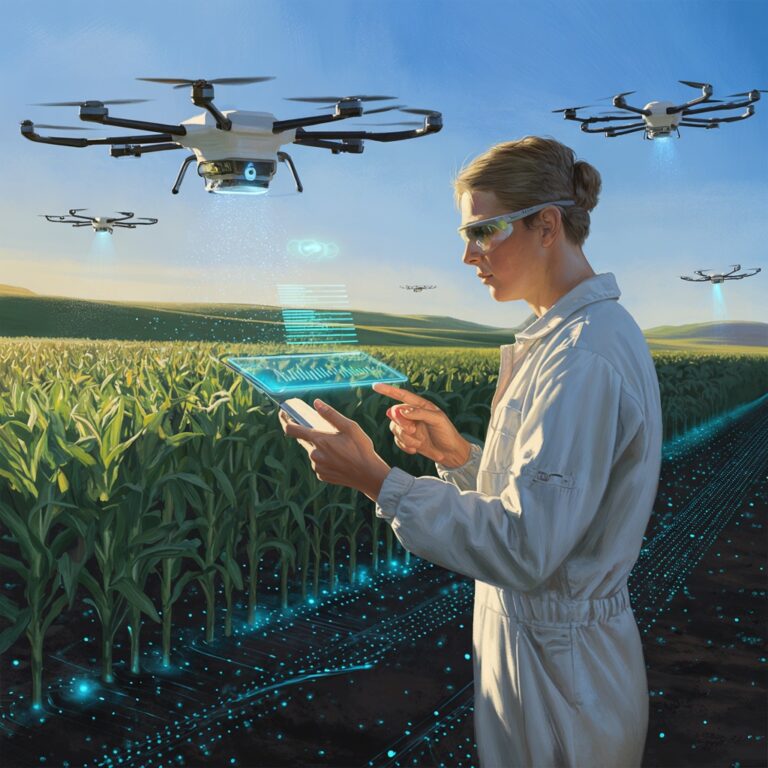
Farming with Drone tech – AI tech – IoT Tech
2. Robotics and the Democratization of Automation
We have moved past the era where only massive car factories could afford robots. Robotics is now accessible to the South African SME.
Collaborative Robots (Cobots): These smaller, agile robots work alongside humans. In agriculture, they are used for high-speed fruit sorting and precision spraying—tasks that were previously too labor-intensive or repetitive.
The “Maker” Generation: The 1960s Ham Radio hobbyist has been replaced by the Robotics Student. Using ESP32, Arduino, and Raspberry Pi, a new generation is building autonomous rovers and AI-powered sorting machines right here in SA.
3. The Titans of the Trade: Your Building Blocks
The South African ecosystem for these components is world-class. You deal with the “who’s who” of the industry—the specialists providing the DNA for this revolution.
Articles from the same author:
- Bizcommunity.co.za
- ICT can take farming into the future
- Gadget.co.za
- How tech boosts farming
“From the glowing glass of a 1960s radio valve to the carbon-fiber limbs of a 2026 delivery drone, the story of electronics in South Africa is a story of resilience and ingenuity. At Online Parts International, we don’t just see the history—we provide the parts for the future. Whether you need a vintage transistor or the latest IoT sensor, the ‘Ring’ stays unbroken.”
The Parts-Ring Tech Glossary (Future Edition)
| Term | What it actually is… |
| LoRaWAN | A long-range, low-power wireless network. Perfect for sensors on a 5,000-hectare farm where Wi-Fi won’t reach. |
| Cobot | Short for “Collaborative Robot.” It’s designed to work safely next to people without a safety cage. |
| LiDAR | “Light Detection and Ranging.” It uses lasers to help robots “see” and map their environment in 3D. |
| ESP32 / Arduino | Small, inexpensive “microcontrollers” (mini-computers) used to control everything from smart geysers to robotic arms. |
| Computer Vision | Using AI to allow a camera to “understand” what it sees—like identifying a weed vs. a maize sprout. |
- The Evolution of South African Electronics: From Radio Valves to Robotics (1960–2030)
- Chapter 1: The 1960s: The Era of the "Hams" and Glass Valves
- Chapter 2: The 1970s - The Silicon Transition
- Chapter 3: the 1980s - The Dawn of the Digital Age
- Chapter 4: The 1990s: The "White Box" Revolution
- Chapter 5: The 2000s: The Fall of the Giants
- Chapter 6: 2010–2025: The Streaming & Analog Revival
- Chapter 7: The 2030 Horizon: Smart Agriculture & Physical AI