The featured image shows the valves (vacuum tubes) seen on end in a recreation of the Colossus computer. Attribution found here.
Table of Contents
ToggleWorld War Engineers
The Electronic Computer
Focusing specifically on world war engineers and electronic digital computers developed during World War II (1939–1945) we reflect the current consensus among computer historians, legal rulings, and declassified information.
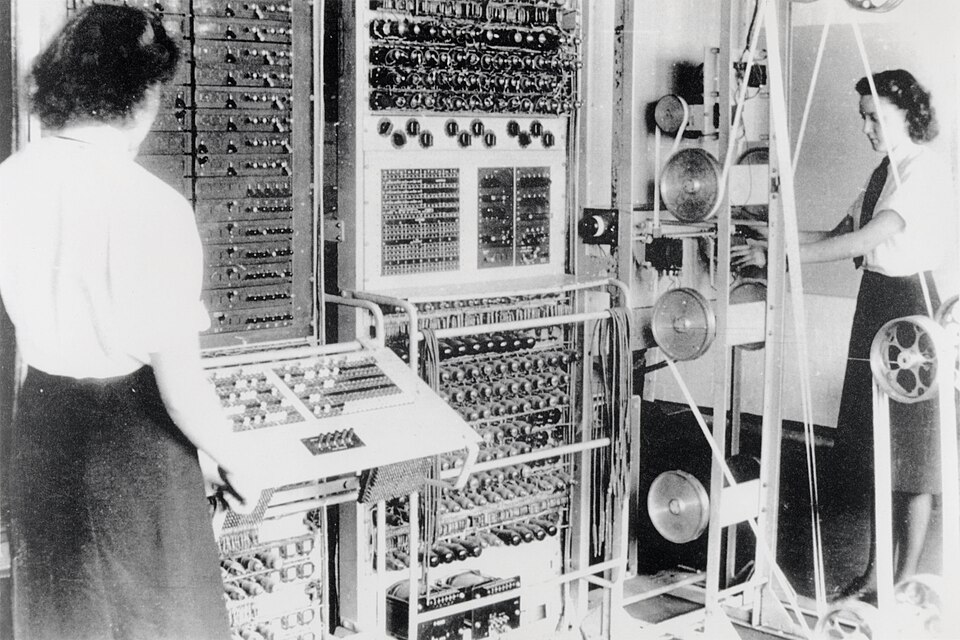
The Colossus, the first “digital” computer developed and built through 1943 until 1945 by British code breakers. By Unknown author – This file is from the collections of The National Archives (United Kingdom), catalogued under document record FO850/234. For high quality reproductions of any item from The National Archives collection please contact the image library., Public Domain
More on Wikipedia – The Colossus Computer
The Electronic Digital Computer During World War II
Here are the three most significant early electronic digital computers from this period:
- Atanasoff–Berry Computer (ABC) Developed between 1937 and 1942 (with a successful prototype demonstrated in 1939 and the full machine completed around 1942) by physicist John Vincent Atanasoff and graduate student Clifford Berry at Iowa State College (now Iowa State University). It is widely recognized as the first automatic electronic digital computer. The ABC was a special-purpose machine designed to solve systems of simultaneous linear equations. It introduced key innovations such as binary arithmetic, electronic logic circuits for calculations, and capacitor-based memory — concepts that influenced later designs. In a landmark 1973 U.S. federal court ruling (Honeywell v. Sperry Rand), the ENIAC patent was invalidated, with the judge concluding that the ABC was the first electronic digital computer and that ENIAC inventors had derived key ideas from it.
- Colossus Developed secretly by a team led by engineer Tommy Flowers, with input from mathematician Max Newman, at the Post Office Research Station and Bletchley Park in the United Kingdom. The first Colossus Mark I became operational in December 1943 (with full deployment in early 1944). It is regarded as the world’s first programmable electronic digital computer (though programmed via switches and plug panels rather than a stored program in the modern sense). Colossus was a special-purpose machine used to break German Lorenz cipher messages (high-level encrypted communications) during the war. Multiple units were eventually built, and it remained classified until the 1970s.
- ENIAC (Electronic Numerical Integrator and Computer) Designed by John Mauchly and J. Presper Eckert at the University of Pennsylvania’s Moore School of Electrical Engineering, and built for the U.S. Army. Completed in late 1945 (demonstrated publicly in 1946). It was the first general-purpose, programmable electronic digital computer that could be reconfigured (via plugboards and switches) for a wide variety of numerical problems, such as artillery firing tables. With around 18,000 vacuum tubes, it was massive and influential, though later court findings showed it built on ideas pioneered by the ABC.
These three machines laid crucial foundations for modern digital computing: the ABC for core electronic digital principles, Colossus for large-scale programmable electronic operation, and ENIAC for general-purpose electronic computation. Each played a unique role in advancing the field during (and because of) the urgent demands of World War II.
Colossus, the world’s first programmable electronic digital computer.
Note: Colossus, the world’s first electronic computer, had a single purpose: to help decipher the Lorenz-encrypted (Tunny) messages between Hitler and his generals during World War II.
Colossus was the world’s first large-scale programmable electronic digital computer, designed by engineer Tommy Flowers (with key contributions from his team at the Post Office Research Station) and operational from early 1944 at Bletchley Park. It was built specifically to attack the German Lorenz cipher (codename “Tunny”), used for high-level communications between Hitler and his field commanders.
The Target: The Lorenz Cipher (Tunny)
The Lorenz SZ40/42 machine was a stream cipher attachment for teleprinters. It generated a pseudo-random keystream of 5-bit characters (using Baudot code) that was XORed with the plaintext to produce ciphertext.
- 12 wheels grouped into:
- 5 χ (chi) wheels (always stepped)
- 5 ψ (psi) wheels (stepped irregularly)
- 2 motor (μ) wheels (controlled stepping of ψ wheels)
- Each wheel had a fixed pattern of cams/pins (active = 1, inactive = 0), with sizes ranging from 23 to 61.
- Total key period: extremely long (~10^20 possibilities).
To decrypt a message, cryptanalysts needed:
- Wheel patterns (pin settings on each wheel) — broken by hand methods like Turingery or rectangling.
- Wheel start positions (initial offsets) — this is what Colossus automated.
The Key Insight: The Delta Method (Bill Tutte)
Bill Tutte discovered statistical weaknesses in the ciphertext. He analyzed deltas (Δ) — the XOR between one bit and the next in a channel.
- ΔZ = delta of ciphertext
- Δχ = delta of χ-stream (from χ wheels)
- Δψ = delta of ψ-stream (from ψ wheels)
Because ψ wheels stepped irregularly, ΔZ and Δχ showed correlation when χ wheels were correctly set — especially in the “double delta” attack: Δ(ΔZ) = Δ(Δχ) for pairs of χ wheels.
Colossus counted how often this held true across the message. High counts indicated correct settings.
How Colossus Worked: Core Architecture & Operation
Colossus was not a stored-program computer like modern ones. It was programmed by plugboards, switches, and patch panels — similar to ENIAC but optimized for Boolean logic and counting.
Key components (Mark II version, the most advanced):
- Paper tape reader (input): Read 5-bit ciphertext characters at up to 5,000 characters/second (Mark I) or 25,000 (Mark II via parallel processing). Used photoelectric cells to sense punched holes.
- Thyratron ring stores (electronic memory): 12 rings simulated the 12 Lorenz wheels. Each ring was a loop of thyratrons (gas-filled tubes) storing the wheel’s pin pattern as a circulating bit-stream. Start positions set via uniselectors.
- Shift registers (Mark II): 6-character FIFO to buffer and align data.
- Boolean function units: Custom valve circuits performed AND, OR, XOR, NOT, etc., on up to 5 tape channels and wheel outputs.
- Counters: Up to 5 electronic counters tallied matches (e.g., when a computed delta matched the tape delta).
- Control circuits: Switched operations, reset counters, and triggered output when thresholds met.
- Output: Electric typewriter printed wheel settings and counts.
Processing flow (simplified for double-delta on two χ wheels):
- Ciphertext tape looped continuously.
- Tape reader fed 5 parallel channels.
- Wheel patterns generated electronically by thyratron rings (no second tape needed — Flowers’ key innovation).
- Operators plugged/switched to compute: e.g., ΔZ4 ⊕ ΔZ5 (tape deltas) ANDΔχ4 ⊕ Δχ5 (wheel deltas).
- Result fed to counter → incremented on each match.
- Machine ran through all possible start positions (e.g., 41 × 31 = 1,271 for χ1 & χ2).
- Highest-scoring settings printed out → sent to “Tunny” operators for decryption.
Mark II added parallel processing (multiple wheel pairs at once) and shift registers for speed.
.
Why It Was Revolutionary
- Fully electronic — ~2,400–2,500 thermionic valves (vacuum tubes) for logic and counting.
- Programmable via hardware configuration (flexible Boolean functions).
- Massive scale — first to use thousands of valves reliably (Flowers proved valves were stable if kept powered).
- Parallelism — processed multiple bits/channels simultaneously.
- Speed — 5,000–25,000 chars/sec → broke wheel settings in hours instead of weeks.
Ten Colossi were built; they read millions of characters daily and played a major role in shortening the war by providing vital intelligence (e.g., before D-Day).
The original machines were destroyed post-war, but a working Mark II replica exists at The National Museum of Computing at Bletchley Park — built from photos, fragments of diagrams, and memories of the original engineers.
Article based Links used in Research
Useful links
Colossus, the world’s first electronic computer, had a single purpose: to help decipher the Lorenz-encrypted (Tunny) messages between Hitler and his generals during World War II. (The Colossus Gallery houses the rebuild of Colossus and tells that remarkable story).
The National Museum of Computing (TNMOC) is home to the world’s largest collection of working historic computers.
ENIAC was the first programmable, electronic, general-purpose digital computer, completed in 1945. (Wikipedia).
The Atanasoff–Berry computer (ABC) was the first automatic electronic digital computer.
Thanks to Grok for assistance in the research.