While Safmarine captured headlines with its elegant white-hulled mailships and global deep-sea routes, Unicorn Lines quietly served as the indispensable coastal workhorse that kept South Africa’s internal economy connected for more than half a century. From the early general cargo coasters to pioneering container and Ro-Ro services, Unicorn moved the everyday essentials — sugar, vehicles, paper, timber, chemicals and general cargo — between South African ports. It provided the vital “short-sea” link that complemented Safmarine’s long-haul operations and, on occasion, extended modest services to Indian Ocean islands and even one or two ports in South America.
Unicorn was never flashy, but it was essential. In many ways, it formed the practical domestic counterpart to the grand “Trident” vision of industrial integration.
Table of Contents
ToggleThe Founding: From Coasters to Unicorn
Unicorn Lines traces its roots to several historic coastal operators. The modern company took shape in 1966 through the merger of African Coasters (established in 1933 by Leon Renaud, with early ties to Grindrod interests) and Smith’s Coasters (dating back to 1889 and heavily involved in the sugar trade from Durban to Cape ports). This consolidation created Unicorn Shipping Holdings (Pty) Ltd, with Unicorn Lines as the operating entity.
A major boost came in 1967 when Unicorn acquired Thesen’s Steamship Company (founded in 1869 in Knysna) from Safmarine. Thesen’s had long served the southern and west coasts, including routes to Walvis Bay. In exchange, Safmarine received a significant shareholding in the new Unicorn entity — cementing an important strategic alliance between the two companies.
The Grindrod family played a central role in the company’s growth. Captain John Grindrod had founded Grindrod & Co in Durban in 1910 as a clearing and forwarding business. Later generations, particularly Walter and Murray Grindrod, drove modernisation. Capital from the mining house Union Corporation in the mid-1960s enabled fleet renewal and positioned Unicorn for the container age.
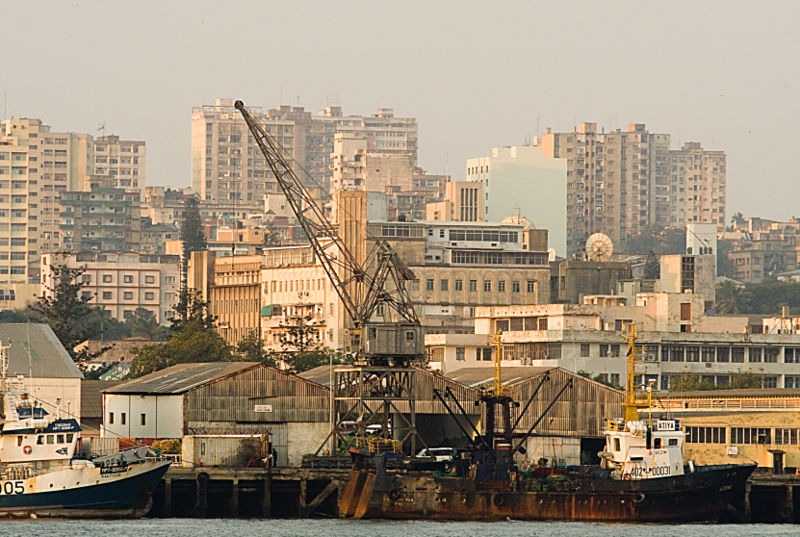
Unicorn Lines vessels regularly called at regional ports, including Maputo in Mozambique, as part of their coastal and feeder services.
The Safmarine Connection
Unicorn and Safmarine were closely intertwined from the start. Safmarine’s acquisition and subsequent transfer of Thesen’s operations gave Unicorn a stronger coastal footprint while giving Safmarine equity in the domestic carrier. For many years Safmarine held around a 40% stake in Unicorn. This relationship deepened further in 2002 when the coastal and container divisions of the two companies effectively integrated under broader group structures.
The partnership made commercial sense: Safmarine handled the deep-sea trades, while Unicorn fed cargo to and from smaller ports along the South African coastline — and occasionally beyond.
Fleet and Services: The Coastal Lifeline
Unicorn’s fleet evolved with the needs of the coastal trade. Early operations relied on traditional coasters, but the company quickly embraced modernisation.
In 1971, Unicorn pioneered containerisation on the South African coast with the small Ro-Ro containership Voorloper, introducing the country’s first weekly container service between Durban and Cape Town. This was followed by Durban-built vessels, including the Trampco-class ships and later feeder containerships.
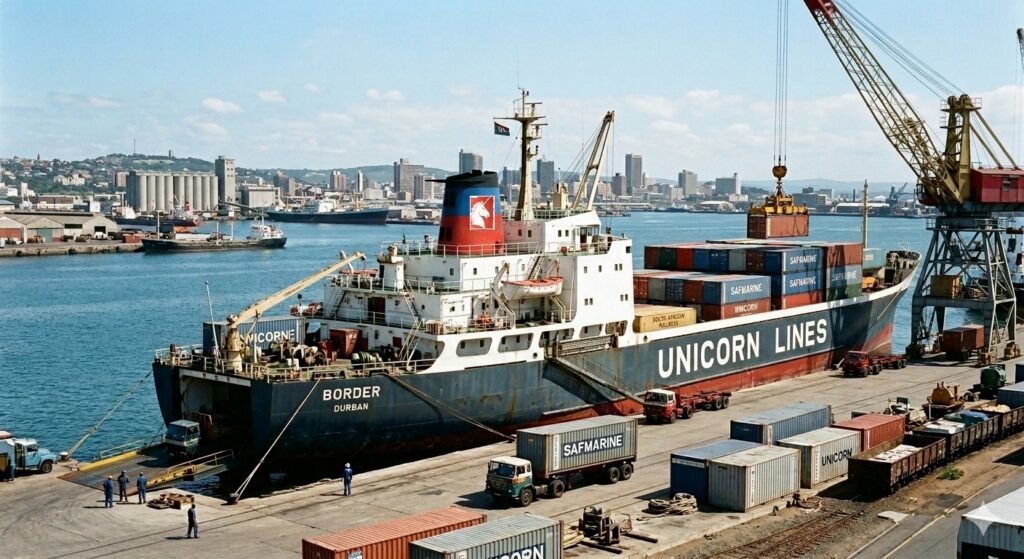
Unicorn also became a leader in Ro-Ro operations, initially for vehicles and later with larger vessels such as Border and Barrier. These ships efficiently moved rolling cargo along the coast and supported occasional international voyages.
The company maintained regular services linking major ports — Durban, Cape Town, Port Elizabeth, East London and Walvis Bay — while extending to Indian Ocean islands. On a few occasions, vessels like the second Voorloper made voyages to ports in South America, demonstrating Unicorn’s willingness to push beyond pure cabotage when opportunities arose.
Throughout its history, Unicorn operated under South Africa’s coastal cabotage framework, which protected local carriers and ensured reliable domestic sea transport in an era when road and rail had limitations.
Unicorn Lines Fleet Timeline: Ship Purchases & Key Acquisitions (1960s–Present)
Pre-1966 (Predecessor Companies)
- 1889–1966: Smith’s Coasters (sugar trade coasters)
- 1869–1967: Thesen’s Steamship Company (west coast and Walvis Bay traders)
- 1933–1966: African Coasters (general coastal traders)
1966–1967: Formation & Major Acquisition
- 1966: Unicorn Lines formally established through the merger of African Coasters and Smith’s Coasters (backed by Union Corporation).
- 1967: Acquired the entire Thesen’s Steamship Company fleet from Safmarine in exchange for a significant shareholding.
1969–1990: Durban Newbuild Programme (11 ships built locally)
- 1969: Three new coasters built in Durban (start of an 11-ship local building programme).
- 1971: Small Ro-Ro containership Voorloper — first weekly coastal container service.
- 1971: Nahoon (built Durban).
- 1973: Trampco-type vessels Verge (later Range) and Ridge.
- 1973: Purchased products tanker Africa Shell.
- 1976: Modified Trampco vessels Gamtoos and Gouritz.
- 1977: Took management of tanker Mobil Durban.
- Mid-1980s: Acquired large Ro-Ro vehicle carriers Border and Barrier.
- Other Durban-built ships included Kowie, Tugela, Pongola, Sezela, Umfolozi, Breede, Zwartkops, Mkuze, Berg, and Oranjemund.
- 1980s: Additional Polish-built containerships and product tankers.
1990s–2000s: Rebranding & Shift to Bulk/Tankers
The 1990s marked a period of significant change. In 1999, Safmarine sold its long-held approximately 40% stake in Unicorn as part of a broader disposal of its non-liner shipping interests. Unicorn rebranded as Unicorn Shipping around 1999–2000 and began shifting focus toward bulk and tanker operations. That same year, the parent group (Grindrod) acquired Island View Shipping, opening the door to international dry-bulk shipping.
The most significant development came in 2002, when Safmarine Container Lines (then under Maersk ownership) and Unicorn formed a joint venture called Unifeeder. Safmarine took a 51% stake and Unicorn 49%, with the new entity acquiring Unicorn’s coastal shipping services division. This effectively integrated much of Unicorn’s coastal feeder and container operations into the larger Maersk/Safmarine network, while allowing Unicorn/Grindrod to concentrate on bulk carriers, product tankers, and international trades.
By the early 2000s, the classic coastal Ro-Ro and general cargo services that had defined Unicorn Lines for decades were largely phased out or absorbed.
2010s–Present (Grindrod Era)
- 2007 onward: Continued newbuild programme under Grindrod — Capesize bulkers (e.g., IVS Cabernet) and product tankers built in Korea and China.
- 2017: Sold its oldest medium-range (MR) products tanker as the fleet modernised.
- 2020s: The original Unicorn coastal brand and fleet have been fully absorbed into Grindrod Limited (JSE: GND). Grindrod remains a publicly listed South African logistics and shipping group operating tankers, bulk carriers, bunker services, and port operations across Africa and beyond.
Legacy on the Coastal Run: Unicorn’s Enduring Mark
While Safmarine captured the imagination with its white-hulled deep-sea giants and global ambitions, Unicorn Lines quietly served as the indispensable coastal workhorse that kept South Africa’s internal trade flowing for over half a century. From the early coasters to pioneering Ro-Ro services, container feeder operations, and occasional runs to the islands and South America, Unicorn connected ports, factories, and communities in ways that few outsiders ever fully appreciated. Its story is one of practical resilience — the daily movement of sugar, vehicles, paper, and general cargo that underpinned the very industries Safmarine helped export to the world.
Today, the spirit of Unicorn lives on within Grindrod Limited, a proudly South African company that traces its roots back to Captain John Grindrod’s clearing and forwarding business established in Durban in 1910. Grindrod has evolved into a diversified, publicly listed logistics powerhouse on the Johannesburg Stock Exchange (JSE: GND), with operations spanning ports and terminals, integrated freight solutions, marine fuels, and cross-border logistics across more than 20 countries. Although the Unicorn brand itself has faded from the coastal routes, the company’s pioneering contribution to South African short-sea shipping remains an important — and often under-celebrated — chapter in our maritime history.
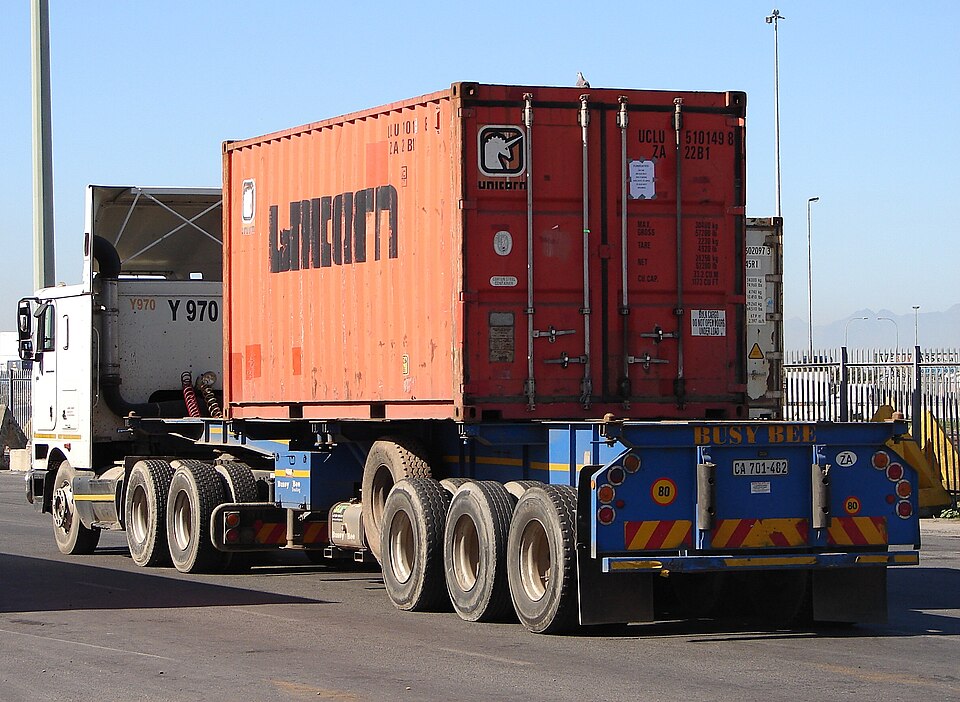
Unicorn Lines Container – Table Bay Harbour, Cape Town, South Africa – This file is licensed under the Creative Commons Attribution-Share Alike 3.0 Unported license. Author Col Andre Kritzinger
Further Reading:
- Integrated Bridge System
- Marine Engineer Evolution
- The Truck Driver Who Revolutionized Shipping
- Why the Cape Doctor Makes Saldanha South Africa’s Next Major Port
- Silvermine: South Africa’s Forgotten Underground Maritime Nerve Centre
- More on the history of Cape Town Radio
- Starlink's Efforts in South Africa
- Safmarine History - Watts to Waves
Credits
Image Credits
- A Gemini AI-generated image of the Unicorn Lines Ro-Ro vessel Border in Durban Harbour. (Note: Authentic non-copyright historical photos of specific Unicorn ships are extremely scarce.)
- Unicorn Lines Container – Table Bay Harbour, Cape Town, South Africa (Creative Commons Attribution-Share Alike 3.0 – Author: Col Andre Kritzinger)
- Maputo Port (Creative Commons Attribution-Share Alike 2.5 – Author: Julien Lagarde / User P.V.)