Table of Contents
ToggleShip-Borne Desalination - through the 70s and 80s
On my first ship, the SA Morgenster, many years ago, the fresh water generator could churn out many tons of fresh water per day. It was a marvel of engineering that allowed us to stay at sea for extended periods without constantly topping up from shore. I also quickly learned that not all fresh water is equal.
Fresh Water Generators (FWGs), also called evaporators or distillers, convert seawater into fresh (distilled) water onboard vessels. They are essential for long voyages, reducing dependence on limited shore supplies, extending operational range, and supporting daily needs. A typical commercial ship might consume 20–50+ tons per day for crew, laundry, cooking, engine cooling, and boilers. Without reliable onboard production, voyages would be far shorter and more expensive.
Modern systems produce anywhere from 0.5 to over 1,000 cubic metres (roughly tons) per day, depending on vessel size and technology. Older units, like the one I recall from my early days, sat comfortably in the 10–30 ton range—perfect for mid-sized cargo ships or large trawlers.
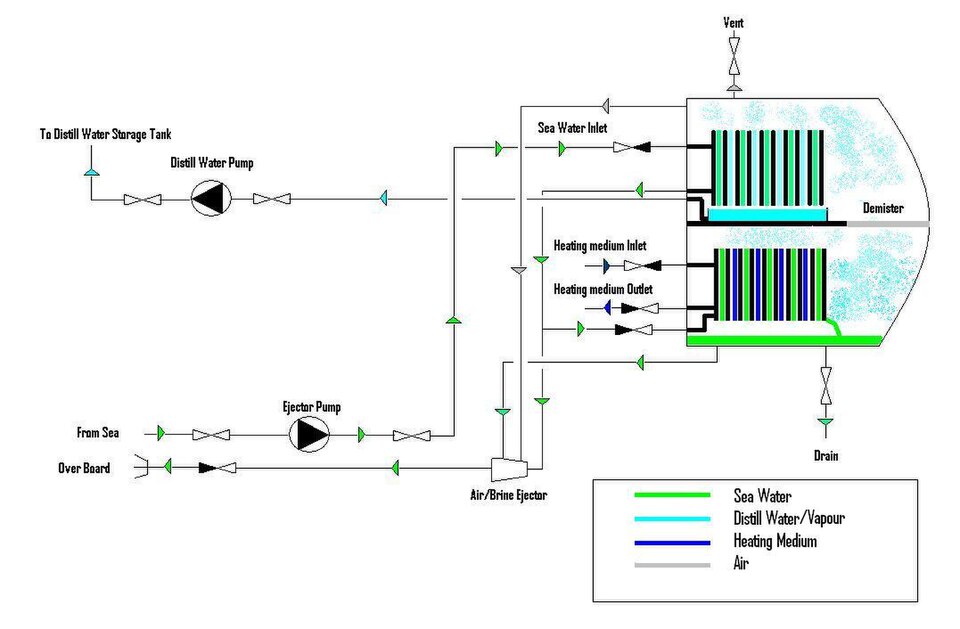
What Is a Fresh Water Generator (FWG) on a Ship?
A fresh water generator (evaporator) turns seawater into pure freshwater using the principle of vacuum distillation. Because boiling seawater at normal atmospheric pressure requires a lot of energy and causes rapid scale buildup on the heating elements, the system uses a vacuum pump or ejector to drop the pressure inside the chamber. Under a deep vacuum, seawater boils at a much lower temperature (around 40°C to 60°C). This allows the system to utilize the waste heat from the main engine’s jacket cooling water as the heat source, making the process highly energy-efficient. The vaporized steam is then condensed by cold seawater, creating distilled water.
The Fuel-to-Water Ratio and Matching Ship’s Consumption
A 15,000 HP Sulzer diesel engine running at service speed rejected an enormous amount of waste heat into its jacket cooling water loop—usually kept right around 80°C to 85°C before entering the cooler. The FWG only needed to divert a portion of that hot jacket water to boil seawater under a high vacuum (85–95%). Engineers generally sized these generators to produce roughly 1 to 1.5 tons of water per day for every 1,000 HP of the main engine. For a 15,000 HP plant, that perfectly matches a capability of 20 to 25 tons.
In the late 1960s, a deep-sea cargo liner like the SA Morgenster typically carried a crew of around 35 to 45 people (including officers, deck crew, engine crew, and catering staff). The rule of thumb for domestic usage (showers, galley, washing) was about 150 to 200 liters per person per day. For a crew of 40, that was only about 6 to 8 tons of domestic water daily. The remaining 12 to 17 tons generated each day went straight into the technical water storage tanks for the auxiliary boiler (which provided steam for heating the heavy fuel oil tanks) and the engine cooling loops, which always suffered minor losses and steam leaks.
Because the FWG produced double or triple what the crew actually drank or showered with, the ship was entirely self-sufficient once she dropped her pilot and got up to full sea speed on long voyages between South Africa, USA, Europe, or the Far East.
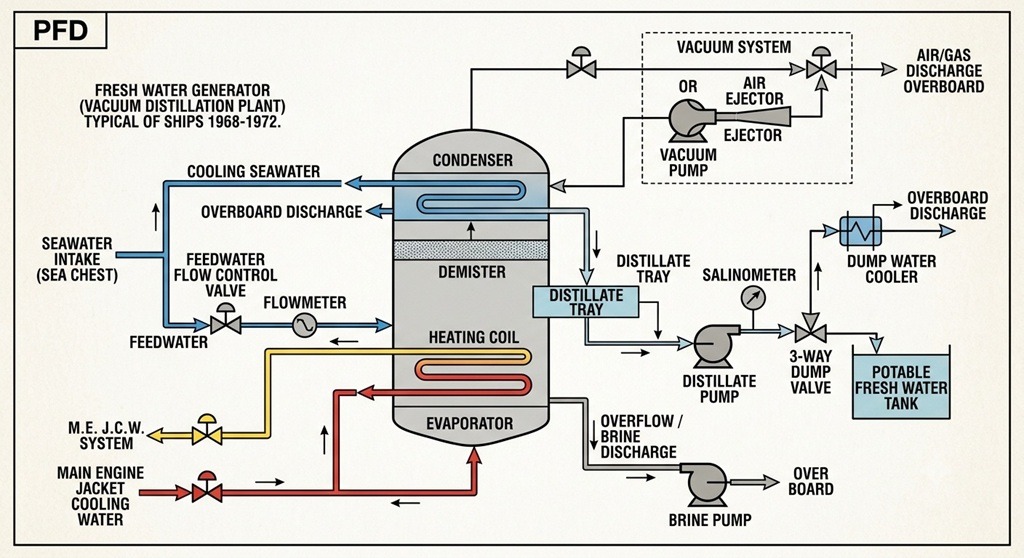
How It Works: Low-Pressure Vacuum Distillation
The core principle is elegant and energy-efficient: low-pressure vacuum distillation using waste heat from the ship’s main engine (jacket cooling water, typically around 80°C). Under vacuum, seawater boils at much lower temperatures (around 40–60°C), avoiding the massive energy needed for atmospheric boiling.
Key Components:
- Evaporator: Where heated seawater turns to vapour.
- Condenser: Cools the vapour back into liquid fresh water.
- Demister: Removes salt droplets and carry-over from the vapour.
- Ejector/Eductor: Creates and maintains the vacuum while discharging concentrated brine (high-salinity waste) overboard.
- Salinometer: Continuously monitors salinity—good distillate is typically under 10 ppm, often 2–5 ppm.
- Fresh Water Pump: Moves the output to storage tanks.
Process Flow (simplified):
- Seawater is pumped from the sea chest through the condenser (preheating it and cooling the vapour).
- It then enters the evaporator, where engine jacket water heats the plates, causing evaporation under vacuum.
- Vapour rises through the demister (to strip salt) and condenses on the cooler condenser plates.
- Distilled water is pumped to tanks; brine is ejected overboard.
This closed-loop use of waste heat makes the system remarkably efficient—no need to burn extra fuel just for water. In my experience on merchant vessels, keeping the plant well-maintained (especially cleaning scale from plates) was a daily engine-room priority.
Potable vs. Non-Potable Water: The Chemical Reality
When it first comes out of the FWG, it is essentially pure distilled water (TDS near zero). It tastes completely flat, lacks essential minerals, and can actually be slightly corrosive to piping. Before it goes into the drinking water tanks, it passes through a re-hardening/mineral filter (typically containing limestone or calcite) and sterilization (chlorine dosing or UV).
Note that the fresh water drinking fountains were not coupled to this system—it was drinking water only which was taken onboard with our other supplies. In the good old days on the Morgenster (built 1968/69), much of the generated water wasn’t suitable for drinking due to the chemicals involved. We relied on shoreside supplies stored in dedicated tanks—often positioned around the funnel area—for potable water. This system was vital for everything from hygiene and engine cooling to boiler feed.
Drinking Water Storage on Ships
Drinking water (potable water) is kept in dedicated Domestic Fresh Water Tanks. These tanks are specifically designed and coated with food-grade epoxy paint. Maritime regulations stipulate that potable water tanks must be completely independent—they cannot share a bulkhead with tanks containing oil, fuel, sewage, or ballast water. They are usually situated away from the outer hull skin to prevent contamination if the hull is breached.
Submarines and Steam Turbines
Lorem ipsum dolor sit amet, consectetur adipiscing elit. Ut elit tellus, luctus nec ullamcorper mattis, pulvinar dapibus leo.
Going Back 100 Years: How the Early Liners Generated Water
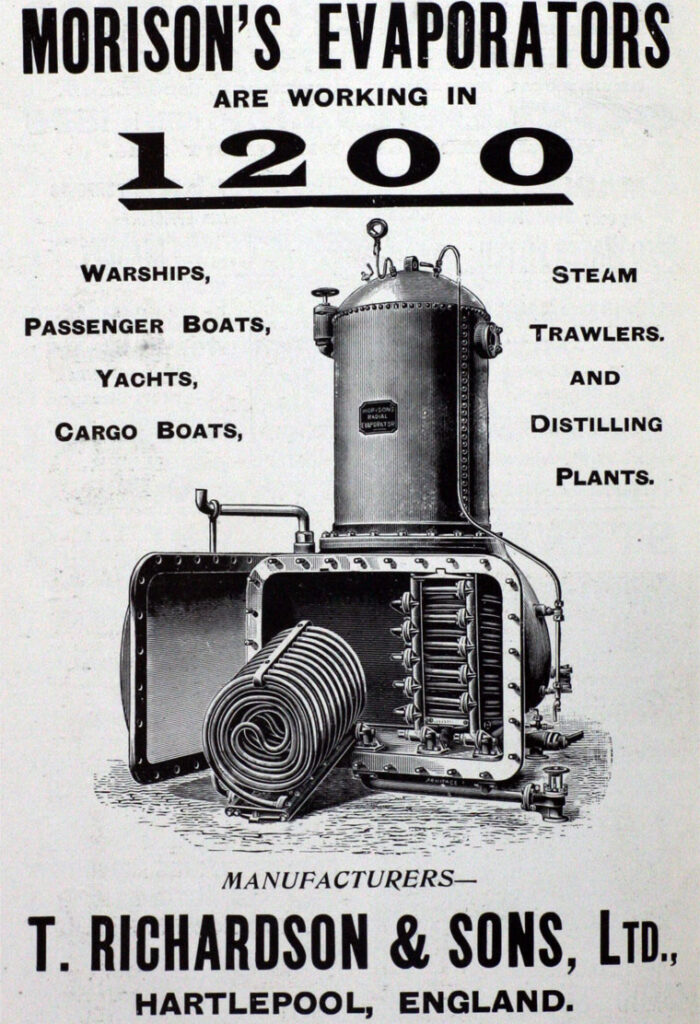
If we look back to the 1920s and 1930s—the golden age of ocean liners like the Mauretania, Olympic, or the early days of the Queen Mary—they relied entirely on high-pressure steam evaporators. Unlike modern vacuum generators that run gently at low temperatures using waste heat, ships back then were powered by massive, coal-fired (and later oil-fired) steam boilers.
They tapped high-pressure live steam directly from the boilers to boil seawater inside large cylindrical evaporator vessels. Because early steam turbines and boilers leaked steam constantly through gland seals and valves, these liners required massive amounts of “make-up” water just to keep the boilers from running dry. The water produced was strictly “technical water” for the machinery. For passengers and crew, liners carried thousands of tons of fresh shore water in deep tanks. Generated water was only used for passengers if the ship ran severely short, and even then, it tasted terrible because it was boiled at such high temperatures
The “Arsenic” and Chemical Diarrhoea Mystery
My memory about why you shouldn’t drink the water meant for showers or flushing—and the mention of arsenic and diarrhoea—makes sense both to the engineering fraternity and in a historical context. There are two major reasons this happened on ships:
The Boiler Chemical Carryover (Priming): The distilled water used for showers and domestic washing often came from the auxiliary steam systems or was mixed with water intended for the boiler feed circuit. To prevent the massive boilers from rusting out or scaling up, the engineers dosed the water with heavy, aggressive chemical compounds (boiler compounds). Historically, some anti-corrosive treatments and early scale-inhibitors contained heavy metals, phosphates, tannins, and yes—highly alkaline chemicals or legacy compounds that could include trace toxic elements. If a boiler was overfilled or fluctuated violently (priming or carryover), these chemicals could escape into the steam lines and contaminate domestic hot water/shower lines, causing severe gastrointestinal distress.
Arsenic in the Galvanizing and Piping: Until copper and cupronickel became standard, ships used galvanized steel pipes for technical, sanitary, and shower water. The industrial zinc used to galvanize steel pipes naturally contained high levels of arsenic and lead as impurities. If the water (especially slightly acidic distilled water) flowed through those pipes, it would leach zinc, arsenic, and lead. Drinking it triggered the body’s defensive reaction: violent diarrhoea and vomiting.
The engineers knew exactly what was in those auxiliary and machinery lines. The rule was absolute: you only drank from the designated, mineralized, and tested potable water line, never from the general wash deck, sanitary, or auxiliary lines.
A Personal Cautionary Tale: The Cup o’ Noodle Incident
I recall very well the 2nd Officer on one of the ships bringing a bag full of cup o’ noodles from downtown Yokohama for a late-night snack for his wife and himself. Both suffered massive diarrhoea over the next week. Boiling doesn’t kill chemicals— it can concentrate them. The high sodium in the noodles combined with the chemicalized water turned their digestive tracts inside out. The Chief Engineer was amazed—not because it was unexpected, but because the 2nd Officer was also the ship’s medical officer. On my very first trip, I was told it was not advisable to drink boiled FWG water, and that drinking water onboard was not infinite (no wastage).
Advantages, Challenges, and Modern Alternatives
Advantages: Highly energy-efficient (reuses engine waste heat), reliable and compact for marine environments, and reduces port stops and logistical costs. Challenges: Scaling and fouling on heat exchanger plates require regular chemical or mechanical cleaning; careful salinity monitoring; vacuum system maintenance and power for pumps.
Today, many vessels also use Reverse Osmosis (RO) systems—high-pressure membrane filtration without heat. RO is popular for its flexibility but more energy-intensive. Hybrids exist on advanced ships.
Historical Context and Relevance Today – Four Case Histories
Case History 1: The Steam Turbine Era (1980s) – SA Langeberg The SA Langeberg (built 1977) was one of Safmarine’s powerhouse container liners with a 38,000 HP steam turbine plant. It required 40 to 60 tons of pure distilled make-up water daily due to system losses, on top of domestic needs. Her high-pressure evaporators ran constantly using bled steam.
Case History 2: The Golden Age of Ocean Liners (1930s) Major liners took on 2,000–4,000 tons of shore water for potable use in deep tanks. Technical water came from high-temperature evaporators and was kept separate. Generated water for passengers in emergencies often tasted poor and caused complaints.
Case History 3: The Submarine Environment (Modern Era) Submarines use multi-stage flash evaporators or RO. Potable water is remineralized and sterilized; technical water for reactors is ultra-pure via deionizers.
Case History 4: See the Cup o’ Noodle story above.
Relevance to Parts-Ring
For Parts-Ring readers in industrial liquidation, marine surplus, or power generation: FWGs, heat exchangers, pumps, and related spares (plus generators for auxiliary power) frequently appear in aged stock. Understanding them helps when handling maritime or industrial equipment lots.
Conclusion: An Engineering Marvel at Sea
Ship-borne desalination plants exemplify practical ingenuity—turning abundant seawater into a resource that keeps vessels moving and crews safe. They remind me of the broader march of maritime technology I witnessed firsthand, from Morse code distress calls to modern automation. As we build Parts-Ring into a trusted platform for professional surplus and parts, stories like these highlight the enduring value of well-engineered systems and the equipment that supports them.
Whether you’re a maritime enthusiast, engineer, or simply curious about how the world’s goods move across oceans, fresh water generation remains a quiet but critical enabler of global trade. What are your experiences with marine systems or industrial water treatment? Share in the comments.
Further Reading
- Navigating Water Scarcity: El Niño/La Niña Cycles, Harvesting Solutions, Desalination, and Lessons from Global Leaders
- The Ghost in the Machine: Why Your Kipor Generator Is Still Very Much Alive
- DC Blinding Warning: 6mA RDC-DD, Type B RCD & SANS 10142-1 in South Africa
- Solar Panel & Battery Theft in South Africa: The Growing Crisis – And a Simple, Smart Detection Solution
- The Silent Killer in Your EV Charger Installation: Why Your Cheap “ELCB” Could Get Someone Electrocuted (And Why Municipalities Are About to Crack Down)
Technical Research & Image Credits
- Featured Image: Fresh Water Generator (FWG). Enhanced by PicsArt. This file is licensed under the Creative Commons Attribution-Share Alike 3.0 Unported license. Author: Marcusroos
- Fresh Water Generator Flow Diagram. This file is licensed under the Creative Commons Attribution-Share Alike 4.0 International license. Author: Aliahmed47
- Advertisement for Morison’s Evaporator. This work is in the public domain in its country of origin and other countries and areas where the copyright term is the author’s life plus 70 years or fewer. Author: T. Richardson & Sons Ltd., Hartlepool
- Flow Diagram of a Typical 60s/70s shipborne FWG – Google’s Gemini Images
- Research: Technical assistance and cross-referencing provided by X’s xAi Grok and Google’s Gemini Ai model.
- Editorial: All case study data, circuit designs, and final editorial decisions are the sole responsibility of the author to ensure technical accuracy