I have long been a huge fan of Philips, the massive company founded in Eindhoven, Netherlands. From humble light bulbs to life-changing medical technology, Philips shows what happens when bold research meets practical engineering.
Imagine a company that started by making the humble light bulb in a small Dutch town—and ended up helping doctors see inside your body with AI-powered scanners, while your grandparents shaved with the same reliable razor tech for decades. For young South Africans dreaming of electronics careers, or anyone tracing innovative roots back to Dutch settlers, Philips is a masterclass in resilience, reinvention, and real-world usability.
Table of Contents
TogglePhilips Innovation Timeline: From Glow to Global Health Tech
1890s–1910s: Lighting Foundations & First Medical Leap
- 1891: Founded in Eindhoven by banker Frederik Philips and his engineer son Gerard to mass-produce affordable, reliable incandescent light bulbs.
- 1914: Opens the famous Philips NatLab research laboratory under Dr Gilles Holst – the engine for decades of breakthroughs.
- 1915: Launches the Arga argon-filled lamp – longer-lasting and brighter.
- 1918–1919: Enters health tech with the first medical X-ray tubes. This planted the seed for their entire medical-imaging empire.
1920s–1930s: Radio & Consumer Design Boom
- 1923–1926: Miniwatt and Pentode radio tubes revolutionise sound quality; Philips becomes the world’s largest radio maker by 1933.
- 1927: Launches its first affordable radio set.
- 1939: The game-changing Philishave rotary electric shaver – ergonomic, stylish, and still the DNA of today’s Norelco line.
1940s–1950s: Post-War Recovery & TV Era Begins Post-WWII, NatLab delivers UV sterilisation lamps, fluorescent lights, hearing aids, and mass-market black-and-white television.
- 1951: First X-ray image intensifier – a big leap for diagnostics.
- 1958: Futuristic pavilion at the Brussels World Fair – an early hint of immersive “Ambient Experience” design.
1960s: Colour Television & Audio Cassette Revolution
- 1963: Compact Cassette audio tape sets the global standard for portable recording. Its limitations (slow tape speed and narrow tracks) affected signal-to-noise ratio, but licensing Dolby noise reduction dramatically cleaned up the hiss, making cassettes sound far more professional and fuelling worldwide sales.
- Late 1960s: Philips leads in colour TV with breakthroughs like the Plumbicon camera tube (low-lag, high-sensitivity for broadcasting) and advanced in-line colour CRT tubes. These helped make colour TV practical and affordable across Europe via the PAL system – a huge cultural shift.
1970s–1980s: Video, Digital Audio & Sony Partnership
- 1971: First consumer home video cassette recorder (VCR).
- 1979–1982: Philips demonstrates the Compact Disc prototype in Eindhoven, then partners with Sony on final specs (including error correction by Philips’ Kees Immink). The CD launches in 1982 and transforms music forever.
- Early 1980s: Co-develop S/PDIF (Sony/Philips Digital Interface) – the standard digital audio connection still used today. Continued optical disc work and medical imaging advances.
1990s–2000s: Flat Screens, DVD & Health-Tech Pivot “Design for Life” philosophy brings user-friendly products. Philips co-develops DVD with Sony (1997) and introduces Ambilight backlighting. Major restructuring begins as the company shifts focus to health and well-being.
2010s–Present (2026): Pure Health-Tech Leader Philips fully transforms into a focused health-technology company. Innovations now centre on AI-powered MRI, CT, ultrasound, image-guided therapy, connected patient monitoring, and personal health devices (shavers, oral care, sleep solutions). In 2025, Philips filed 1,289 European patent applications (676 in MedTech), remaining No. 1 in medical technology at the European Patent Office and the largest Dutch applicant. They were named a Clarivate Top 100 Global Innovator for the 13th consecutive year.

Founding Spirit & the NatLab Legacy
Philips & Co. officially began on 15 May 1891. By the early 1900s they were the Netherlands’ largest private employer, building a socially progressive “Philips village” with housing, schools, and free medical care for workers. The 1914 NatLab became one of Europe’s premier industrial research facilities, blending fundamental science with practical product development.
Researchers enjoyed real freedom – generous budgets and the freedom to explore ideas that might pay off years later. This delivered breakthroughs in lamps, radio tubes, X-ray tech, the Compact Cassette, CD foundations, and semiconductors. Your hands-on experience matches the reputation: Philips gear was intelligently laid out, modular, serviceable, and built as if real technicians had sat alongside the engineers. Parts were plentiful. That wasn’t luck – it came from a massive R&D culture that valued real-world usability.
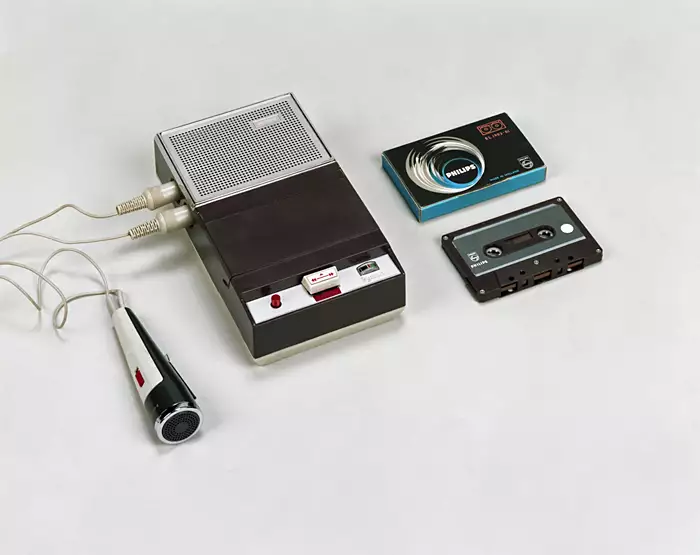
First Philips Compact Cassette Recorder (1963)
The Great Restructuring: From Conglomerate to Focused Leader
By the late 20th century Philips was a true conglomerate – lighting, consumer electronics, appliances, semiconductors, and medical imaging. But success bred complexity. In the 1990s profit margins collapsed. In 1990 they posted one of the biggest corporate losses in Dutch history.
New CEO Jan Timmer launched “Operation Centurion” – a brutal but necessary overhaul with massive layoffs, factory closures, and sale of non-core units. The company renamed itself Philips Electronics N.V. (1991) and earned its “Royal” title in 1998.
Later leadership made three big bets: • Shift to health and well-being (building on X-ray roots). • Major divestitures – lighting spun off as Signify (2016), domestic appliances sold (2021). • Become a pure-play health-technology company.
This was classic corporate renewal: prune what no longer fits, invest in high-margin areas, and ride megatrends like ageing populations and value-based care.
Where Philips Got It Wrong – And How They Recovered Faster
Even giants stumble. Philips became a victim of its own success with over-diversification (over 120 businesses at one point), slow commercialisation, and poor bets on proprietary formats:
- Video 2000 (V2000): Technically good but launched too late and lost to VHS.
- CD-i (1991): A billion-dollar interactive multimedia flop – clunky and poorly marketed.
- Digital Compact Cassette (DCC): Better sound in theory, but lost to the MP3 era.
They had superior engineering but sometimes weak marketing and execution. European costs and bureaucracy made it hard to match agile Asian competitors. The 1990 crisis forced decisive action – Philips restructured faster than many peers.
A more recent stumble was the CPAP/Respironics recall (2021 onward). Defective foam in millions of sleep and ventilator devices led to a major voluntary recall, regulatory scrutiny, and a $1.1 billion settlement for economic damages and personal injury claims (finalised in 2024, with payments continuing into 2026). It highlighted lingering quality and risk-management challenges even after the pivot to health tech.
South Africa Parallel
In the early 1990s Philips scaled back or exited direct operations here amid global anti-apartheid sanctions, ethical divestment pressure, and local political dynamics (including unions and strikes). The move was pragmatic but abrupt. Products (especially shavers and medical gear) remain available via distributors, but the manufacturing footprint is gone. Sony faced similar pressures, yet Philips shed underperforming units more quickly overall.
Where Philips Stands Right Now (April 2026)
Headquartered in Amsterdam with Eindhoven still a major innovation hub, Philips’ purpose is clear: “Improve people’s health and well-being through meaningful innovation.” Their 2030 goal is to improve 2.5 billion lives per year, including 400 million in underserved communities.
They operate in three segments:
- Diagnosis & Treatment — AI-powered imaging, image-guided therapy, interventional cardiology.
- Connected Care — Patient monitoring and informatics platforms.
- Personal Health — Shavers, oral care, air purifiers, sleep solutions.
In 2025 they delivered €17.8 billion in sales, 2% comparable growth, and an Adjusted EBITA margin of 12.3% (up 80 basis points), with strong North American order intake. For 2026 they target 3–4.5% comparable sales growth and 12.5–13% margin, aiming for mid-teens margins by 2028 and €1.3–1.5 billion free cash flow. CEO Roy Jakobs drives “fewer, bigger, better innovations,” commercial excellence, and disciplined execution – all powered by ~9–10% of sales invested in R&D.
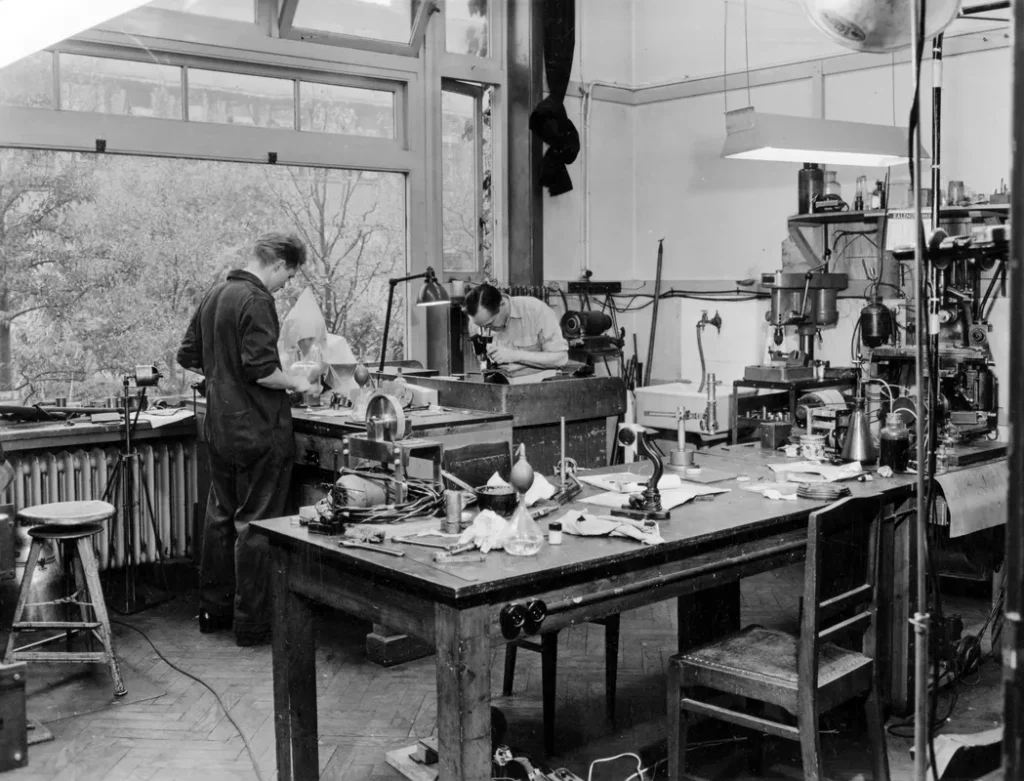
Early NatLab Workshop Interiors (scientists at benches with equipment, large windows, tools everywhere) – Conveys the hands-on, serviceable engineering culture.
Lessons from Philips for Young Innovators
Philips teaches us that world-class R&D (the NatLab spirit) can create durable, service-friendly products and global standards like the Cassette, CD, and S/PDIF. But even the best engineering needs sharp strategy, marketing, and focus. The company’s resilience – admitting flaws, restructuring ruthlessly, and doubling down on health tech – is inspiring.
For South Africans with Dutch roots or anyone with a tinkerer’s mindset, Philips shows the power of practical innovation: admit the flaw, prune what doesn’t work, and keep building things that genuinely improve lives.
This is just the start of a bigger series on companies that shaped electronics – next up: Sony, the Japanese partner on the CD and S/PDIF who faced its own format wars but built deep strengths in medical imaging and entertainment. Later we’ll explore audio legends like Phase Linear (Bob Carver’s powerhouse amps) and Behringer (making pro audio accessible, despite the controversies).
These stories remind us how electronics changed music, medicine, and daily life – and why the innovative spirit thrives in places like South Africa.
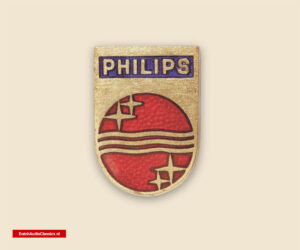
From Dutch Audio Classics
The story about the Philips logo
The exact form of Philips’ shield emblem and the Philips wordmark as we know them today was defined in 1968. Before this date there were many variations of both – so many, in fact, that it is now difficult to trace their exact evolution. The main lines, however, are clear enough. The history of the shield emblem, with its stars and waves contained in a circle, stretches back more than seventy years.
There are conflicting claims about how the Philips logo came into being. Kalff stated that he originally conceived the idea of the three wavy lines after learning that sound consists of waves travelling through the ether. However, Johan van der Ley, who joined the company in 1929, asserted that he was the true begetter of the emblem: he said that the star spangles stood for electric lighting and were only gradually integrated with the wavy lines. In due course, these two elements were placed in a circle, presumably symbolizing the globe.
Today, almost three-quarters of a century later, we shall probably never know which is the true version of events (and, of course, maybe both are correct), but the bare facts alone make interesting reading…