Reader must-watch: Carte Blanche: Deadly Coal Run (originally aired 9 October 2022). Carnage on the N2 between Pongola and Piet Retief—truckers racing coal loads to Richards Bay amid Transnet collapse, profits over lives, horrific crashes, zero policing. AVs will almost entirely eradicate this human disregard.
Table of Contents
ToggleSouth Africa’s Road Crisis: Why AVs Are a National Emergency (Not a “Nice-to-Have”)
Autonomous Vehicles South Africa: SA has one of the world’s worst road safety records—24.5 deaths per 100,000 people. Festive season 2025/26 saw 1,427 fatalities in 1,172 crashes (lowest in 5 years, but still catastrophic). Trucks and heavy vehicles play an outsized role in multi-vehicle horror on freight corridors like the N2 coal route. Human factors—aggression, impatience, alcohol, fatigue—can’t be “policed away.” Autonomous trucks and cars remove the human element entirely. This isn’t luxury tech; it’s the only scalable fix for a culture that won’t change overnight.
Volvo’s Leadership in Heavy-Duty Autonomous Vehicles (and Who Else Is Leading)
Volvo is the standout influencer in heavy-duty autonomy. As Europe’s #1 heavy-truck maker (19% market share in 2025), Volvo Autonomous Solutions (VAS) is commercialising driverless freight fast:
- Factory-integrated VNL Autonomous trucks (with Aurora and now Waabi) rolling off lines in Virginia.
- Real operations in Texas (Dallas–Houston, Fort Worth–El Paso corridors) with DHL/Uber Freight—safety drivers being phased out “in quarters, not years.”
- Mining/earth-moving autonomy already driverless (e.g., Brønnøy Kalk in Norway).
- “Transportation as a Service” (TAAS) model: Volvo operates the trucks themselves for fleets.
Other heavy-duty leaders (2026):
- Aurora Innovation & Waabi (partnered with Volvo): Scaling to 200+ trucks by end-2026, driver-out ops.
- Daimler Truck, PACCAR, TRATON (strong in Europe/NA).
- Tesla Semi: Production ramps 2026—electric with autonomy baked in (cameras + neural nets), but still behind Volvo on heavy-duty highway deployment.
Volvo’s edge: Purpose-built platforms + redundant safety systems. Perfect for SA’s freight routes.
The Sensors: Light, Radio, Sound & More – How They Actually Work
AVs use a “sensor suite” for 360° perception.
Sensor Type
What it Uses
How it Works
Strengths
Weaknesses
Typical Use
LIDAR
Laser Pulses
Fires invisible infrared lasers; measures return time for precise 3D point clouds
Excellent depth/shape mapping; works in dark
Scattered by fog/rain; historically expensive
Mapping, Precise Positioning
mmWave Radar
Radio waves (79 GHz)
Emits radio waves; Doppler shift gives speed/distance; new 4D/Teradar adds shape
All-weather (penetrates fog/rain); velocity tracking
Lower resolution for object classification
Long-range tracking, bad weather
Ultrasonic
High-frequency sound
Sonar-like pings for close-range echoes
Cheap, reliable for parking/close obstacles
Very short range only
Low-speed manoeuvres
Cameras/Vision CCTV
Visible light + AI
High-res video + neural nets interpret colour, signs, intent
Rich semantic data (text, lights, gestures); cheap & scalable
Glare, low light, depth needs AI
Object classification, signs, traffic lights
Other
GNSS + IMU
GNSS = satellite positioning; IMU = inertial (acceleration/rotation) for dead reckoning
Global location + gap-filling when signals weak
GNSS can be blocked (tunnels, urban canyons)
Navigation backbone
Sensor fusion (most companies) combines them for redundancy. Tesla’s pure-vision approach (8–9 cameras only) is the outlier: “Roads were built for human eyes—cameras + massive AI data scale wins.” They ditched radar/ultrasonics because conflicting sensor data creates dangerous ambiguity; vision + neural nets trained on billions of fleet miles improves faster via software updates. Competitors (Waymo, Volvo, Mercedes) use fusion for robustness in edge cases.
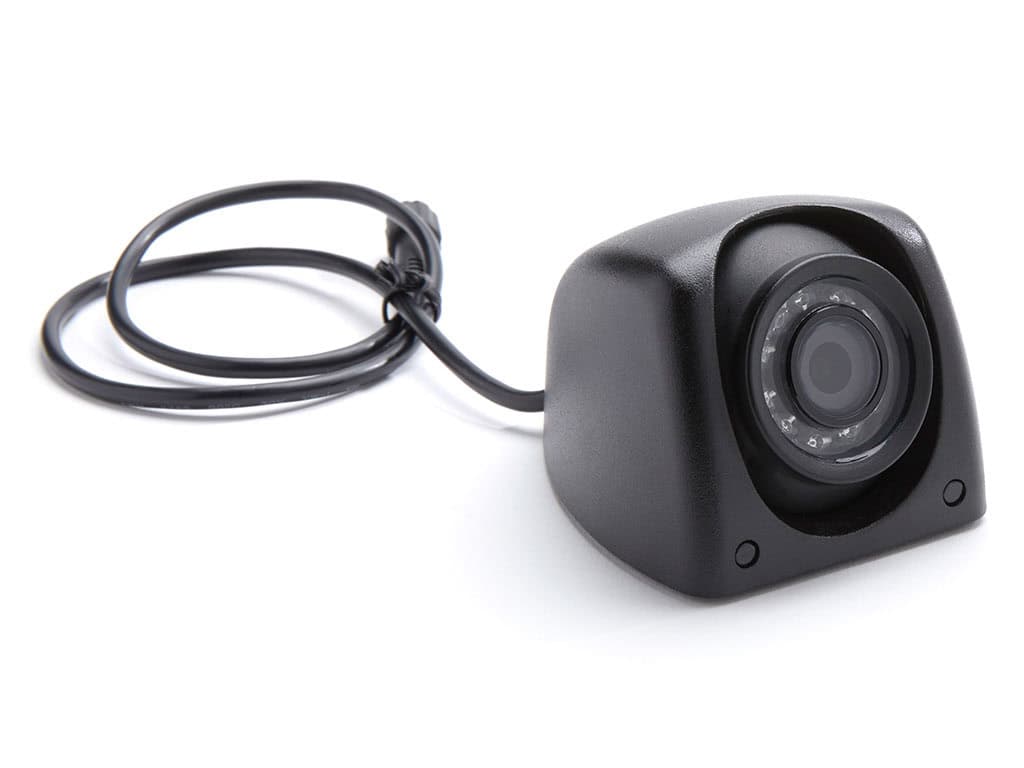

Safety Track CCTV STC-14 Built for exteriors. View the sides of the vehicle, complete with IR lens to see in the dark.
RPLIDAR A1 is a low cost 360 degree 2D laser scanner (LIDAR) solution developed by SLAMTEC. The system can perform 360 degree scan within 12-meter range (6-meter range of A1M8-R4 and the belowing models). The produced 2D point cloud data can be used in mapping, localization and object/environment modeling.
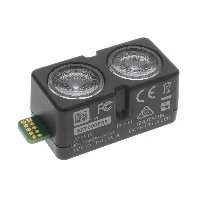
Sparkfun Electronics: SENSOR OPTICAL 40M I2C, SPI
GNSS (GPS) + IMU: The Invisible Navigation Brain
GNSS gives absolute global position (like your phone GPS). IMU measures acceleration and rotation for “dead reckoning”—keeping the vehicle oriented accurately when GNSS drops (tunnels, dense trees, Cape Town fog). Fusion algorithms (e.g., Kalman filters) blend them for centimetre-level precision. Essential for uncharted or GPS-challenged SA roads.
The Brains Behind the Wheels: AV Software Stacks in 2026
Autonomous driving isn’t just hardware and sensors—it’s the software that turns raw data into safe decisions. This is where the real magic (and competition) happens. Most systems blend proprietary AI models with underlying operating systems that are often Linux-based or Android-flavoured. Here’s a clear breakdown:
- Tesla Full Self-Driving (FSD): Highly proprietary end-to-end neural network architecture (“photons in, controls out”). It uses a massive AI model trained on billions of real-world miles from the Tesla fleet. The underlying OS is Linux-based (Tesla’s custom build with real-time capabilities), but the core autonomy software, neural nets, and training pipelines (Dojo supercomputers) are closed-source and heavily patented. No Android here—Tesla keeps full control for rapid over-the-air (OTA) updates that improve every vehicle overnight. This proprietary approach allows unmatched speed in iteration but limits third-party tinkering.
- Waymo (Alphabet/Google): Proprietary deep-learning stack with custom AI for perception, prediction (e.g., VectorNet), and planning. It runs on powerful compute hardware (historically Intel + custom accelerators). The software is closed-source for competitive and safety reasons, though Waymo shares some datasets openly. Strong simulation tools (Waymo World Model) complement real-world miles. Not Android-based at the core—custom real-time systems for safety-critical operations.
- Volvo + Aurora (Heavy-Duty Trucks): Aurora Driver software is proprietary AI-driven, with redundant compute units for L4 autonomy. Integrated deeply with Volvo’s vehicle systems. Like others, it uses custom real-time software on top of Linux-like foundations for reliability. Focused on highway freight with safety-first redundancies.
- Broader Industry Trends (2026):
- Linux flavour dominates the underlying OS for most AV development and production (real-time Linux kernels, QNX in some safety-critical modules, or Automotive Grade Linux – AGL). It’s stable, customisable, and open enough for automotive needs.
- Android Automotive OS (AAOS) for SDVs is expanding fast and going more open-source in 2026 (Google pushing AAOS SDV into AOSP). This handles infotainment, body controls, and even deeper vehicle functions—but not the core safety-critical autonomy AI in most full AVs.
- Open-source options gaining traction: NVIDIA’s Alpamayo (open reasoning AI models + simulation), Autoware (full ROS-based stack for research/commercial), comma.ai openpilot (affordable ADAS), and CARLA simulator. These lower barriers for smaller players and SA innovators.
Key Takeaway: Core autonomy AI (decision-making) remains mostly proprietary across leaders for safety, IP protection, and performance edge. But the foundation (OS, middleware) leans Linux/Android open-source for flexibility and cost. This hybrid model enables fast OTA updates—Tesla’s superpower—while allowing sensor fusion in competitors.
For South Africa: Proprietary stacks like Tesla’s or Volvo/Aurora’s can be updated remotely to handle local challenges (e.g., unique road markings, minibus taxis, or wildlife on rural routes) without hardware changes. Open-source elements could help local developers build SA-specific adaptations.
End-to-End Neural Networks: Tesla’s Game-Changing Approach (2026)
Tesla’s Full Self-Driving (FSD) uses a true end-to-end architecture — often described as “photons in, controls out.” Instead of breaking the problem into many separate software modules (detect object → plan path → control steering), one massive neural network (or tightly integrated set of networks) takes raw camera video + other inputs and directly outputs driving actions like steering, acceleration, and braking.
This is fundamentally different from traditional modular systems used by most competitors.

Simplified view of Tesla’s Large Neural Network architecture (FSD v12/v14 era). Multiple inputs (camera videos, navigation maps, vehicle kinematics, audio) feed into a single large neural network. It outputs perception results (panoptic segmentation, 3D occupancy, etc.) and planning/reasoning that flow directly into vehicle control actions. No hand-coded rules in the core loop — the AI learns everything from billions of real-world driving examples.
More detailed technical view
Key advantages of Tesla’s end-to-end approach:
- Faster iteration: The entire system improves via software updates (OTA) as the neural net is retrained on new fleet data.
- Fewer errors from “sensor fusion conflicts”: One integrated model avoids the problems of multiple separate modules disagreeing with each other.
- Scales with data: Tesla’s fleet generates an enormous volume of real-world video, allowing continuous improvement — especially valuable for handling South Africa-specific chaos (minibus taxis, aggressive overtaking, animals on rural roads, inconsistent road markings).
- Simpler & cheaper long-term: Less reliance on expensive additional sensors.
Balanced note: Competitors (Waymo, Volvo/Aurora, Mercedes) still prefer modular + sensor-fusion systems for easier safety validation and explainability. Tesla bets that a sufficiently trained neural net will outperform humans — and real-world data in 2026 is increasingly supporting that bet.
Case Studies & Real-World Application
- LIDAR vs Radar in Cape Town Fog/Rain Cape Town’s notorious winter fog scatters LIDAR lasers (like car headlights in mist). Radar’s radio waves punch through far better—mmWave/Teradar maintains velocity tracking where LIDAR struggles. Modern solid-state LIDAR is improving, but radar remains the all-weather king. Balanced take: Fusion or Tesla’s AI-vision both adapt, but radar gives redundancy.
- How AVs Read South African “Robots” (Traffic Lights) Cameras + AI detect colour, position, and timing (just like humans). Neural nets classify red/amber/green even with SA-specific signage or damaged lights. High-definition maps + real-time vision handle uncharted areas. No infrastructure changes needed—vision systems generalise.
- Safety in Uncharted Territory AVs combine pre-mapped HD data (where available) with live sensors + AI that reasons like humans (e.g., “that pedestrian looks about to step out”). Tesla’s fleet-learning edge shines here—constant real-world data improves every vehicle overnight.
In the world of autonomous vehicles, lidar sensors are the center of debate. Self-driving car companies, like Cruise and Waymo, use lidar as the key ingredient to advance their autonomous vehicle navigation while skeptics, like Elon Musk, claim it to be useless
Safety Ratings: AVs Have a Far Better Track Record
Human drivers cause ~94% of crashes. AV data (2026):
- Waymo robotaxis: 81–90% fewer injury crashes, 6.7× safer than humans per mile.
- Overall AV fleets show dramatically lower severe incidents.
- Engineers are overwhelmingly pro-AV on safety (majority of 185 industry pros surveyed agree AVs will significantly increase road safety). Some caution about “coding errors” replacing human ones (ACM 2024 warning), but real miles prove the opposite: AVs eliminate fatigue, aggression, alcohol, distraction—the very factors killing thousands in SA annually.
One engineer quote that fits perfectly: “Whilst we do NOT have autonomous vehicles there is always a strong chance of having an accident.” AVs flip that script.
Never underestimate the power of freakin' lasers! Have fun learning to think like an engineer - Lidar Vs CCTV (Tesla)
What This Means for You: Safety, Pricing, Timelines & SA Impact
Safety: Lives saved, families intact. Trucks alone could slash N2 carnage. Pricing: Tesla FSD (Supervised) now ~$99/month (or $49 for some EAP owners)—software add-on, no hardware retrofit needed for newer models. Heavy-truck autonomy via TAAS models spreads cost across fleets. Mass production is driving prices down fast; it must become affordable for average drivers to fix SA’s crisis. Timelines: Robotaxis/trucks scaling 2026 (Volvo/Waymo/Tesla). SA adoption will follow global regs/tech—pilots first on freight corridors. For traffic authorities & economy: SA crash costs exceed R188 billion/year. AVs could save billions in enforcement, medical, insurance, and lost productivity—while cutting fatalities by 80%+ where deployed.
Bottom line: In a country where human behaviour on the road is the biggest killer, autonomous vehicles aren’t coming—they’re essential. The technology exists today to end the Deadly Coal Runs forever.
Further Reading:
Research
Research assistance provided by Grok xAi and Google’s Gemini. All facts, personal experiences, and final editing remain the responsibility of the author.
Image Credits
- Featured Image: This photo shows the University of Toronto’s autonomous vehicle Zeus, built completely by students. The vehicle has won 4 times of the SAE Autodrive Challenge Competition. This file is licensed under the Creative Commons Attribution-Share Alike 4.0 International license. Author University of Toronto aUToronto
- Marketing Image: Safety Track CCTV STC-14 Built for exteriors. View the sides of the vehicle, complete with IR lens to see in the dark.
- Marketing Image: RPLIDAR A1 is a low cost 360 degree 2D laser scanner (LIDAR) solution developed by SLAMTEC.
- Marketing Image: Sparkfun Electronics: SENSOR OPTICAL 40M I2C, SPI
- Tesla’s End-to-End Neural Network – Created by Grok xAi