Table of Contents
ToggleLithium Imports and Shipping Risks - Why South Africa’s Battery Supply Chain Still Has Big Gaps
South Africa has always been good at moving heavy industrial goods around the world. We built an entire logistics and distribution culture around it. Yet when it comes to something as fundamental as batteries — the very things that keep vehicles, factories, data centres and now homes running — the supply picture remains surprisingly fragile.
Spending many years in computer hardware distribution and one of the quiet realities of that industry was watching lead-acid batteries arrive from China in volume. The landed cost was high, the logistics were expensive, and the product itself was something we could have manufactured competitively at home.
We had the lead recycling systems, the industrial capacity and the market. Yet large volumes still came in by sea. That same pattern is now repeating, only this time with lithium-ion and LiFePO4 technology, and the risks have become more complex. The theme of this article is all about Lithium Imports and Shipping Risks but also the massive onus on companies to either pay huge amounts to retrofit and train or not have insurance cover.
Lead-acid still has a strong local footprint
South Africa does manufacture lead-acid batteries. The main players remain well-established:
- First National Battery (part of Metindustrial / Metair) — long the dominant local producer, manufacturing roughly 2.2 million units a year for automotive SLI, mining traction, standby and solar applications.
- AutoX (Willard and SABAT brands) — another major local manufacturer with decades of history, covering automotive, industrial and leisure batteries.
- Dixon Batteries — a family-owned manufacturer active since the 1950s, producing automotive, traction and UPS batteries.
These companies operate closed-loop recycling systems. Collection rates for used lead-acid batteries in South Africa are high (often quoted above 90 %), and recovery of lead, plastic and acid is efficient. That is one of the genuine strengths of the local industry.
RoHS and lead restrictions
Lead-acid technology sits in a special regulatory position. The EU’s RoHS Directive restricts lead in electrical and electronic equipment, but batteries have historically enjoyed exemptions or parallel regulation under the EU Battery Directive (now Regulation 2023/1542). Lead-acid batteries are still permitted, subject to strict recycling and recovery targets.
In South Africa the situation is governed more by occupational health and environmental rules than by a direct RoHS-style ban. Lead work is tightly controlled under the Lead Regulations, and Extended Producer Responsibility (EPR) rules apply to certain battery categories. The practical reality is that lead-acid remains legal and widely used, provided the recycling loop is closed. The environmental and health pressures, however, continue to push the industry toward alternatives. And that, ironically is where Lithium imports and shipping risks rears its ugly head.
Lithium-ion and LiFePO4: assembly yes, cells no
Here the picture changes. There is currently no commercial manufacturing of lithium-ion or LiFePO4 cells in South Africa. Several companies assemble complete battery packs and systems using imported cells (predominantly from China). The better-known names include:
- Freedom Won
- Solar MD
- BlueNova
- Balancell
- Lithium Batteries South Africa (LBSA)
- and others that have grown rapidly on the back of load-shedding demand.
These are genuine local manufacturers of packs and systems, often with strong design and BMS work done in South Africa. But the cells themselves — the core electrochemical component — still arrive by sea. With the current lithium imports and shipping risks associated with the maritime (and aviation sectors), feasibility studies (including recent work by the Localisation Support Fund) suggest that a 5–10 GWh LFP cell plant is commercially possible, particularly if located in places such as Atlantis or Coega and supported by sensible industrial policy. Until that happens, the cell supply chain remains external.
Why the gap exists
The reasons are structural rather than mysterious:
- Cell manufacturing is capital-intensive and requires scale, specialised skills and a stable, predictable market.
- China achieved enormous economies of scale and vertical integration that are difficult to match quickly.
- Policy certainty, demand aggregation and skills development have lagged.
- South Africa has the mineral base (iron, phosphate, copper, manganese) but limited downstream battery-grade processing and cell production capability.
The result is that we import the most critical component, then assemble and integrate locally. That works — until shipping, insurance or geopolitical friction intervenes. Internationally, lithium imports and shipping risks are making transportation prohibitively expesive.
Locally. some of the larger courier companies forbid the transport of any lithium based battery.
Shipping the batteries: new rules, higher costs
This is where the maritime reality becomes unavoidable. From 1 January 2026 the IMDG (International Maritime Dangerous Goods )Code Amendment 42-24 is fully mandatory. Battery-powered vehicles now carry specific UN numbers (UN 3556 for lithium-ion, UN 3557 for lithium-metal, UN 3558 for sodium-ion). State-of-charge limits (commonly ≤30–50 %) are widely enforced by carriers. SOLAS II-2/20 amendments have tightened fire detection, video monitoring and fixed water-based suppression requirements on Ro-Ro and vehicle spaces.
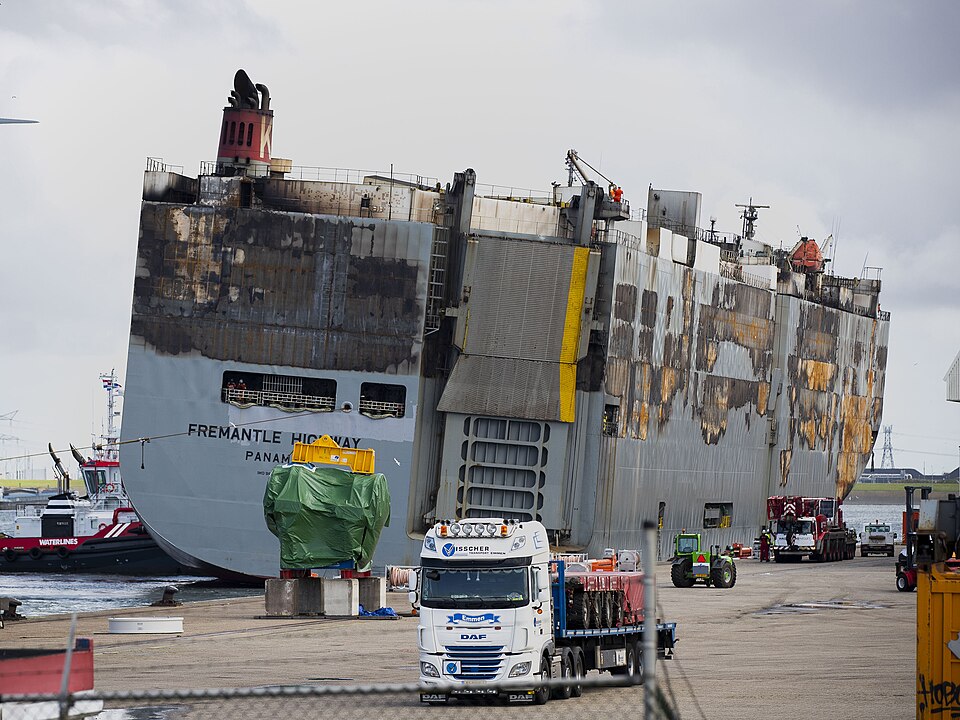
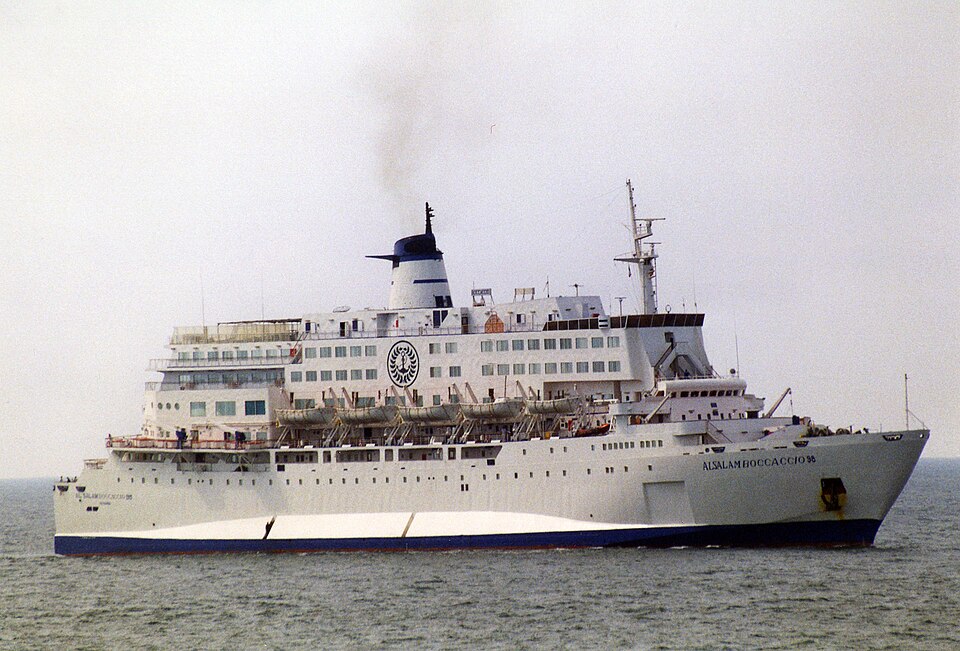
Shipowners are finding the combination of higher insurance premiums and the cost of retrofitting detection and suppression systems extremely expensive in an already thin-margin business. Thermal runaway remains the central concern. LiFePO4 is chemically more stable than older Li-ion chemistries, yet under the current Code it is still treated as Class 9 dangerous goods. Water remains the primary large-scale cooling method, which immediately raises free-surface and stability questions — lessons already written in blood by incidents such as the Al-Salam Boccaccio 98 and the Fremantle Highway fire.
A practical conversation I had with a maritime professional recently highlighted the tension: dedicated water-flooding capability for EV zones is logical from a fire perspective, yet it risks turning a localised battery fire into a stability problem for the entire ship. Targeted cooling of individual containers or small zones, combined with verified low state-of-charge and better chemistry differentiation, would be a more elegant solution. The current rule set is still catching up.
Electric vehicles: local manufacturing opportunity with limited traction
South Africa already has a mature automotive manufacturing base. The traditional OEMs — BMW, Mercedes-Benz, Toyota, Volkswagen, Ford and Isuzu — continue to produce significant volumes for both the domestic market and export. BMW’s Rosslyn plant is particularly relevant: it is the only global production site for the fourth-generation X3 plug-in hybrid, with the majority of output exported.
Yet full battery-electric vehicle manufacturing remains thin. Most pure EVs and many of the newer plug-in hybrids currently sold in South Africa are imported, predominantly from China (BYD, Chery, Omoda, Jaecoo, Haval, Geely and others). Chery has taken a concrete step by acquiring the former Nissan Rosslyn facility and is investing to begin local production around mid-2027, with ambitions to use South Africa as an African manufacturing and R&D hub. Small-scale specialist projects also exist — for example the Thula Electric Safari Vehicle, an almost entirely locally engineered and built all-electric game-drive 4×4 aimed at the tourism sector.
The policy framework is starting to move in the right direction. From March 2026 a 150 % first-year tax deduction applies to qualifying investments in electric- and hydrogen-vehicle production facilities and machinery. Despite this, actual high-volume EV production has been slow to materialise. The reasons are familiar: limited domestic demand scale, high capital requirements, skills gaps in battery and power-electronics manufacturing, and the same cell-supply dependence that affects the stationary battery sector. The opportunity is real; the traction so far has been modest.
Worldwide shipping restrictions for EVs
The maritime rules that apply to South African imports and exports are the same rules that apply almost everywhere else. Under IMDG Code Amendment 42-24 (mandatory from 1 January 2026) a lithium-ion battery-powered vehicle must be declared as UN 3556, not the old catch-all UN 3171. Lithium-metal vehicles fall under UN 3557 and sodium-ion under UN 3558. These classifications bring specific packing, labelling, documentation and stowage requirements.
Most major carriers now also enforce a maximum state-of-charge limit, commonly 30–50 %, verified before loading. SOLAS amendments that entered force in 2026 have tightened fire-detection, video-monitoring and fixed water-based suppression requirements on Ro-Ro and pure-car-carrier spaces. Some individual shipping lines have imposed additional commercial restrictions or temporary bans after high-profile fires, and insurance premiums for EV cargo have risen sharply. Containerised shipment of complete vehicles is increasingly used as an alternative to traditional Ro-Ro for higher-risk or smaller consignments.
In short, the regulatory and cost environment for moving EVs by sea is tighter, more chemistry-specific and more expensive than it was only a few years ago. That friction applies equally to vehicles arriving in South Africa and to any future locally produced EVs that might be exported.
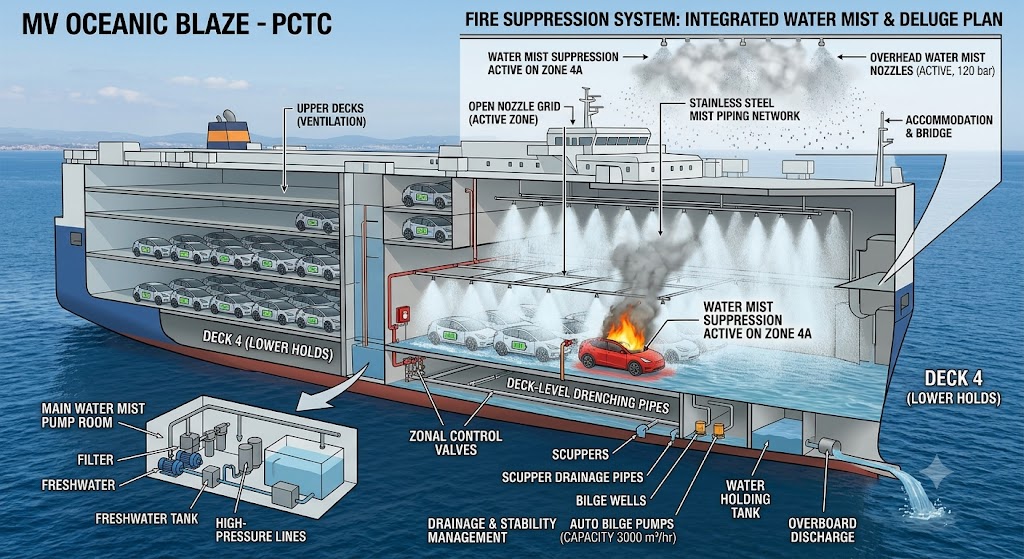
Gemini Ai generated image of what the proposed Water Mist fire suppression system would look like. My own feelings? Impractical if it is used over a large area but possible if focused only over the fire/heat/ smoke source.
What this means for the supply channel
South Africa sits in an awkward middle position. We can still make good lead-acid batteries and we can assemble sophisticated lithium systems. We cannot yet make the cells that sit at the heart of the energy transition. That dependence on imported cells, combined with stricter and more expensive maritime rules, creates real friction in the supply chain — exactly the kind of friction that Parts-Ring and professional liquidation platforms are designed to navigate.
The opportunity is clear. Local cell manufacturing, if it materialises, would reduce both cost and shipping risk. In the meantime, the industry has to work with the rules as they stand: careful classification, verified state of charge, proper documentation, and a clear-eyed understanding that lithium batteries are not just another cargo. They are a cargo that can, under the wrong conditions, rewrite the stability calculations of the ship that carries them.
That is the supply-channel reality we are living in. It is worth understanding properly.
30 Seconds. That's What a Lithium Fire Gives You.
On June 10th, 2024, SV Theros left Halifax bound for the Azores. Three days later, their AIS signal went dark 34 miles southwest of Sable Island. Four weeks after that, Parks Canada found the crew on the beach. You Tube Channel Be the Captain
Conclusion
No seafarer wants to face a fire at sea. Once a fire is out of control, the only remaining option may be to abandon ship — and in an emergency, weather conditions often make that extremely dangerous. In the video 30 Seconds. That’s What a Lithium Fire Gives You., Capt. James Evenson explains the risks of a lithium fire on board a yacht.
In the past, ship fires were typically caused by oil, hazardous materials, cargo, or electrical faults. Today, lithium-based fires have added a new and serious risk: they are heat-driven, difficult to control, and often deadly.
Have you experienced an uncontrolled lithium-based fire? If so, please share your comments — I will use reader feedback to support further research.
Further Reading
Splash 247 – Hundreds of cars still intact onboard fire-damaged Fremantle Highway
- Prospect Law: The Fremantle Highway – How an electric BMW caused a major casualty
- Subtractive vs Additive Manufacturing: CNC Machining vs 3D Printing – The Ultimate Hobbyist & Maker Guide (2026)
Fire safety in ro-ro passenger ships – FIRESAFE studies
MDPI (Multidisciplinary Digital Publishing Institute) Fault Tree Analysis of Lithium-Ion Battery Pack Fire Risk for Electric Vehicle Applications
- Essential Transistors for Beginners: Must-Have Spares, History & Counterfeit Detection (2026) – Part 1
- Power Switching Semiconductors: Thyristors, IGBTs, GTOs, SIDACs & Wide-Bandgap Devices Explained (2026) – Part 2
- Thermionic Valves & Vacuum Tubes: The Enduring Technology Behind Classic Electronics (2026) – Part 3
- FinFET and Gate-All-Around Transistors: Modern 3D Architectures Powering AI & High-Performance Computing (2026) – Part 4
Technical Research and Image Credits
- Featured Image: Fremantle Highway after the 2023 fireHoek van Holland 23-9-2023 , bestemming van het sleep transport Shipyard Damen in de Botlek – Translation Hoek van Holland 23-9-2023, destination of the towage transport Damen Shipyard in the Botlek. This file is licensed under the Creative Commons Attribution-Share Alike 2.0 Generic license. Author kees torn
- Fremantle Highway in Eemshaven – This file is licensed under the Creative Commons Attribution-Share Alike 4.0 International license. Author Ministerie van Defensie
MS al-Salam Boccaccio 98 sank on 3 February 2006 in the Red Sea en route from Duba, Saudi Arabia, to Safaga in southern Egypt. This file is licensed under the Creative Commons Attribution-Share Alike 3.0 Unported license. Author Carlo Martinelli
Research: Technical assistance and cross-referencing provided by X’s xAi Grok and Google’s Gemini Ai model.
- Editorial: All case study data, circuit designs, and final editorial decisions are the sole responsibility of the author to ensure technical accuracy