I only really started seeing IBM computers coming onto the consumer market around the late 1980s, although Clive Sinclair and his ZX Spectrum, Acorn and Amstrad also brought out cheaper ranges. In 1980 our South African Rand equalled 0.5 British Sterling or R2.00 per £.
- Sinclair Research (The Budget Champion)
Sir Clive Sinclair’s philosophy was to make computing accessible to the masses by keeping costs as low as humanly possible.
- ZX80 (1980): Launched at £99.95 (as a kit) or £125 pre-assembled. It was famously the first computer in the UK to break the sub-£100 price barrier.
- ZX81 (1981): Dropped the entry price even lower to £69.95 (kit) or £99.95 (assembled).
- ZX Spectrum (1982): Launched at £125 for the 16 KB model and £175 for the 48 KB model. By 1983, fierce competition forced Sinclair to slash these prices to £99 and £129 respectively.
- Sinclair QL (1984): An ill-fated jump into the business market, priced high at £399, which ultimately caused the company financial distress.
- Acorn Computers (The Premium School Standard)
Acorn computers were highly engineered, featured robust expansion ports, and were backed by the BBC, making them significantly more expensive.
- BBC Micro Model A & B (1981): Launched at £235 (Model A) and £335 (Model B). However, due to manufacturing costs, the flagship Model B quickly rose to £399 on the high street.
- Acorn Electron (1983): Built specifically to fight Sinclair in the budget market. It cut back on the BBC Micro’s features to launch at £199.
- BBC Master 128 (1986): A late-80s upgrade to the school lineup that retailed for a steep £499.
- Acorn Archimedes (1987): A revolutionary 32-bit machine that pointed to the future but cost an elite £800 to £1,200+ depending on the configuration.
- Amstrad (The All-in-One King)
Alan Sugar’s Amstrad entered the market in 1984 with a unique pitch: they sold the computer, tape/disk drive, and monitor together as a single box. You didn’t have to hijack the family television to play.
- Amstrad CPC 464 (1984): Launched at £199 with a green-screen monochrome monitor, or £299 with a full-colour monitor. It offered immense value compared to buying a separate computer, tape deck, and TV modulator.
- Amstrad CPC 6128 (1985): Upgraded with a built-in floppy disk drive instead of a tape deck. It cost £299 (monochrome) or £399 (colour).
- The Amstrad-Sinclair Eras (1986+): After Amstrad bought Sinclair in 1986, they repackaged the Spectrum. They launched the ZX Spectrum +2 (with a built-in tape deck) for a highly competitive £139 to £149, breathing new life into the Sinclair brand.
Comparison Table:
Summary Cost Comparison (Mid-1980s Retail)
Brand & Model | Launch Year | Typical Launch Price | Main Selling Point |
Sinclair ZX Spectrum (48K) | 1982 | £175 (Later £129) | Cheapest way to get colour gaming & coding |
Acorn Electron | 1983 | £199 | Acorn’s attempt to make a budget BBC Micro |
Amstrad CPC 464 (Mono) | 1984 | £199 | Total package; came with its own monitor & tape deck |
Amstrad CPC 464 (Colour) | 1984 | £299 | Premium gaming/utility without needing the family TV |
Acorn BBC Micro (Model B) | 1981 | £335 (Later £399) | Elite build quality; standard in British classrooms |
Some history:
- 1980s Prices Adjusted for Inflation Today
Adjusting for over 40 years of UK inflation (using an approximate cumulative factor of 3.8x to 4x from the mid-1980s to 2026), these classic computers were far from cheap. They cost roughly what mid-tier to premium gaming setups cost today.
- Sinclair ZX81 (£69.95 in 1981): Equates to roughly £270 today. It was an incredibly affordable entry point.
- Sinclair ZX Spectrum 48K (£175 in 1982): Equates to roughly £665 today. This is comparable to buying a modern PlayStation 5 Pro or an upper-midrange smartphone.
- Amstrad CPC 464 Colour (£299 in 1984): Equates to roughly £1,135 today. This reflects its status as an “all-in-one” bundle with a built-in monitor.
- Acorn BBC Micro Model B (£399 in 1981): Equates to roughly £1,515 today. It was a massive investment for families and schools, akin to a premium MacBook or high-end custom gaming PC today.
- Why Amstrad Bought Out Sinclair in 1986
By 1985, Sinclair Research was facing severe financial ruin due to a series of high-profile, expensive failures engineered by Sir Clive Sinclair:
- The Sinclair QL Disaster: Launched in 1984 as a business machine, the QL was plagued by delays, bugs, and a non-standard microdrive tape system. It failed to compete with the IBM PC.
- The C5 Electric Vehicle: Clive Sinclair poured huge amounts of capital into the Sinclair C5, a three-wheeled electric trike. It launched in 1985 to terrible reviews, absolute public ridicule, and disastrous sales.
- Cash Flow Crisis: Overstocked warehouses of unsold Spectrums and QLs combined with massive debts forced Sinclair to find a buyer.
Alan Sugar’s Amstrad stepped in April 1986, purchasing the Sinclair brand name and computer rights for £5 million.
Sugar realized that while Sinclair was terrible at manufacturing and corporate management, the “ZX Spectrum” brand was still highly beloved by kids and gamers. Amstrad immediately discontinued the buggy QL, took the core Spectrum technology, and fixed its biggest hardware complaints. They added a proper plastic keyboard and integrated a built-in tape deck, creating the highly successful ZX Spectrum +2. This move kept the Spectrum alive and highly profitable well into the early 1990s.
- Technical Specs: ZX Spectrum vs. BBC Micro
The rivalry between these two machines was essentially “Budget Gaming Power” vs. “Premium Engineering Power.”
Feature | Sinclair ZX Spectrum (48K) | Acorn BBC Micro (Model B) |
Processor (CPU) | Zilog Z80A running at 3.5 MHz | MOS Technology 6502 running at 2.0 MHz |
RAM (Memory) | 48 KB (Massive for the price) | 32 KB (Split between system and screen) |
Keyboard | Infamous “dead flesh” rubber chiclet keys | Full-travel, professional typewriter keyboard |
Graphics | 256 x 192 pixels. Suffered from “colour clash” (attribute clash) where colours bled into adjacent blocks. | Varied modes (up to 640 x 256). No colour clash, allowing for smooth, clean shapes. |
Sound | Internal “beeper” (1 channel, primitive). | 4-channel sound chip (3 voice channels + 1 noise channel). |
Expansion Ports | Bare edge-connector (required expensive external add-ons for joysticks or printers). | Massive array of ports (User port, Analogue-in, RGB, Econet networking, Tube interface). |
Primary Use Case | Home gaming and bedroom coding hobbyists. | Classroom education, computer science, and lab hardware control. |
The ZX Spectrum won on raw memory capacity and price. Because it had 48 KB of RAM and a faster CPU clock speed, developers could squeeze incredibly complex, large games onto it.
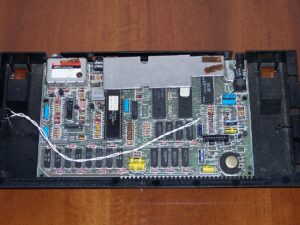
The BBC Micro won on sheer engineering and build quality. Its 6502 processor handled instructions more efficiently per clock cycle than the Z80. Its vast expansion ports meant it could easily be connected to laboratory equipment, floppy drives, and school networks—making it the ultimate teaching tool.
Although these computers were revolutionary, especially DIYers and hobbyists it was still pretty expensive for South Africans.
The USA’s release of the IBM’s XT and 286 into the international market:
- The IBM PC XT (Launched March 1983)
The IBM Personal Computer XT (which stood for “eXtended Technology”) was a major upgrade over the original 1981 IBM PC because it included a built-in hard drive.
- Base Model Launch Price: $4,995 USD.
- Fully Equipped Price: Up to $7,545 USD (if configured with maximum RAM and an official IBM colour graphics monitor).
- Adjusted for Inflation: That base price of $4,995 equates to roughly $16,000+ USD today.
- What you got: An Intel 8088 processor running at 4.77 MHz, 128 KB of RAM, a single 360 KB floppy disk drive, and a groundbreaking 10 MB hard drive. Because the hard drive added so much to the cost, IBM eventually released cheaper sub-models without it to stay competitive.
- The Famous “286” — The IBM PC AT (Launched August 1984)
The “famous 286” refers to the IBM Personal Computer AT (“Advanced Technology”), which introduced the powerful 16-bit Intel 80286 processor. It completely redefined the performance standard for business computing.
- Base Model Price (256 KB RAM, no hard drive): $3,995 USD.
- High-End Model Price (512 KB RAM, 20 MB hard drive): $5,795 to $6,000 USD.
- Adjusted for Inflation: The high-end machine would cost roughly $19,400+ USD today.
- What you got: A blazing-fast 6 MHz processor (later updated to 8 MHz), a high-density 1.2 MB floppy drive, and a 20 MB hard drive on the upper-tier configurations.
The Strange “Hybrid”: IBM PC XT Model 286 (1986)
Because the “AT” was so expensive, IBM later launched an odd-ball hybrid machine in 1986 called the XT Model 286. It put a 286 processor inside an older, cheaper XT style chassis to give buyers 286 speeds for a lower price of $3,395 USD.
The Ultimate Price Contrast
To put it in perspective against the British home computer market of the same decade: while a British teenager could buy a Sinclair ZX Spectrum for about £130 ($170 USD) to play video games in their bedroom, a business had to fork out nearly $5,000 to $6,000 USD to put a single IBM workstation on an accountant’s desk.
The model today:
What was the “$500 PC” Microsoft had in mind?
When the industry started talking about a $500 computer, Microsoft did not actually want to build a cheap computer. Instead, they were panicking because of a threat from their rivals (Oracle, Sun Microsystems, and Netscape) who were promoting a concept called the Network Computer (NC).
- The Threat: The NC was envisioned as a “dumb terminal” with no hard drive and a very cheap processor. It would boot up, connect to the internet, and run applications off a central server. Because it didn’t need heavy hardware, it could easily cost under $500.
- Microsoft’s Fear: These Network Computers were designed to run on Java or Linux, completely bypassing the need for Windows or an Intel processor (threatening the famous “Wintel” monopoly).
- Microsoft’s Answer (The “Windows Terminal” & “NetPC”): To fight back, Microsoft and Intel co-created a specification in 1997 called the NetPC. It was a sealed, low-maintenance, low-cost computer that did have a hard drive and did run a stripped-down version of Windows.]
Eventually, component prices (like RAM and CPUs) crashed so fast that traditional PC manufacturers (like Compaq, eMachines, and Hewlett-Packard) were able to build fully-fledged, traditional Windows 98 desktop PCs for $499 by 1999. Microsoft didn’t have to change a thing; the free market made the $500 Windows PC a reality.